Skip to content
Ochre Editions
ArtArtistsCollectionsGalleriesDrops
SearchSign inCart (0)
The galleries · Style galleries

Neoclassicism

Europe turns back to Greece and Rome: clear line, calm figures and civic virtue.

109 works · hang 8945 ·

Share Neoclassicism, in the galleries

The rooms are imagined; every work on their walls is real.

Walk this roomRehang this room

First room, north wall

  1. Portrait of a Boy, ca. 1800
    Portrait of a BoyUnrecorded Italian maker, ca. 1800Courtesy of the Smithsonian American Art Museum
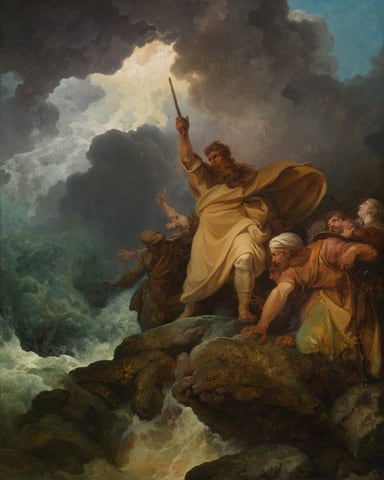
  2. A work made of oil on canvas.
    The Destruction of Pharaoh's ArmyPhilippe Jacques de Loutherbourg, II, 1792Courtesy of the Art Institute of Chicago
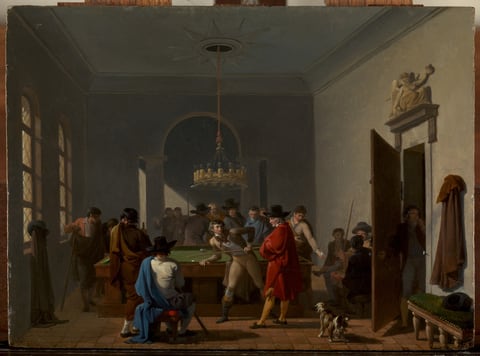
  3. The Billiard Room, by Nicolas Antoine Taunay, after 1810
    The Billiard RoomNicolas Antoine Taunay, after 1810Courtesy of The Metropolitan Museum of Art

First room, south wall
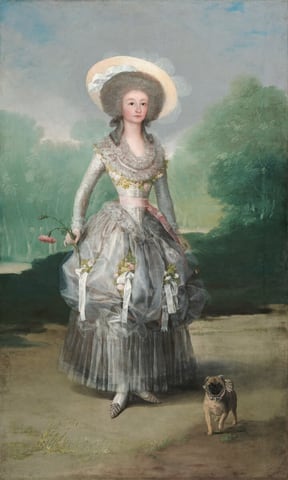
  1. A woman with pale skin, wearing a silvery-gray dress adorned with white ribbons and light pink roses, stands looking out at us with a small, pug dog by her feet in this vertical portrait painting. The woman’s body is angled slightly to our right but she looks at us with dark eyes under faint, arched brows. Her nose is rounded, her cheeks smooth and flushed, and her pale pink lips are closed. Her face is framed in a cloud of nickel-gray hair, and tendrils curl down over her shoulders. She wears a wide-brimmed straw hat with a white ribbon set on the back of her head and slightly off to one side. The bodice of her dress has a low, curving neck. This area is loosely painted to create the impression of layers of lace. A band of intertwined pale pink roses and delicate green leaves borders the outer edge of the lace. The dress has long, tight sleeves with lace at the cuffs and the notably narrow waist is tied with a blush-pink ribbon. The full, silver skirt is picked up to create a row of puffs, like the top of a muffin, around her knees. Bunches of pink roses and white ribbons are nestled into the puffs, and below, the skirt falls in long, vertical pleats to her ankles. She wears white stockings and pointed, petal-pink shoes. In her left arm, on our right, she holds a closed fan loosely at her side, almost lost behind the skirt. She holds a pink carnation with a full bloom and a bud on a long, curving stem in her other hand, by her hip. A caramel-brown pug with a black face, wearing a pink collar lined with three bells, stands facing us with one front paw lifted, to our right of the woman's feet. The landscape is painted in tones of mint and sage green for grass beneath trees enclosing the space the woman stands in, sand brown for the ground, and icy blue for the sky above.
    The Marquesa de PontejosFrancisco Goya, c. 1786Courtesy National Gallery of Art, Washington
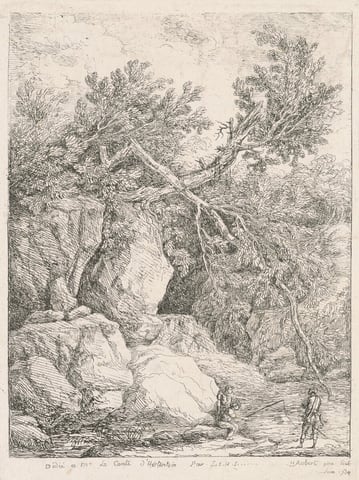
  2. The image shows an illustration of a rocky terrain with towering stone formations and dense foliage. The sky is textured and the scene is created using an etching technique with intricate linework. There are two figures in the scene, one appearing to climb or position near a rock, while the other observes. The color palette is monochromatic, using black on a white background to depict depth and dimension in the artwork.
    Landscape with a Fallen Tree (Paysage à l'arbre cassé)Hubert Robert, 1764Courtesy National Gallery of Art, Washington
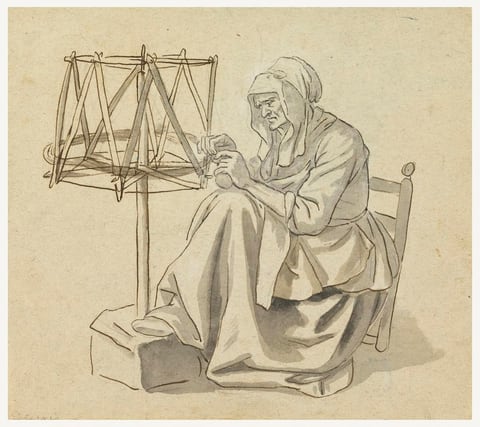
  3. AN OLD WOMAN SPINNING
    An Old Woman SpinningClaude-Louis Desrais, 1810–30Courtesy of Cooper Hewitt, Smithsonian Design Museum

Second room, south wall
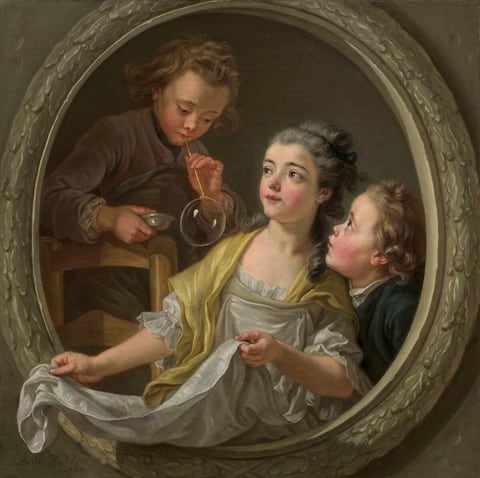
  1. The painting depicts three children within an oval frame, their upper bodies visible. The central child, a young girl, is positioned with her body facing forward and her head turned slightly to the left. She has a fair complexion, with rosy cheeks, pink lips, and wide brown eyes. Her hair is gray and partially pulled back by a blue ribbon. She is dressed in a white garment with a yellow shawl draped over her shoulders. Her arms are outstretched, holding the ends of a cloth that has been pinned on her dress. Her arms and the cloth extend forward beyond the oval frame that encircles the trio, as if the frame is a window or porthole that she is reaching out of. On the right, a boy leans on the girl's shoulder, also facing to the left, seen in profile. He has light brown, curly hair and a fair complexion. He wears a dark blue-green jacket over a white collar, and he is looking upward towards the third child. On the left, another boy, who also has light skin and light brown curly hair, appears to stand on a chair above the other two children. He is holding a long yellow straw up to his lips. At the other end of the straw, a large bubble hangs over the white cloth that the girl holds out. In his other hand is a small white dish. He wears a muted brown outfit with a dark cloth wrapped around him. The background within the frame is plain gray, and the frame that surrounds the children is light gray and appears to be carved with leaf designs. Beyond the oval frame is gray.
    Soap BubblesCharles Amédée Philippe Van Loo, 1764Courtesy National Gallery of Art, Washington
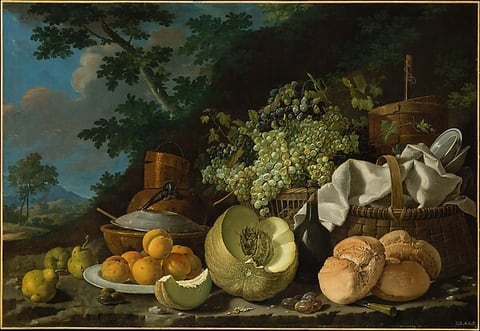
  2. The Afternoon Meal (La Merienda), by Luis Meléndez, ca. 1772
    The Afternoon Meal (La Merienda)Luis Meléndez, ca. 1772Courtesy of The Metropolitan Museum of Art
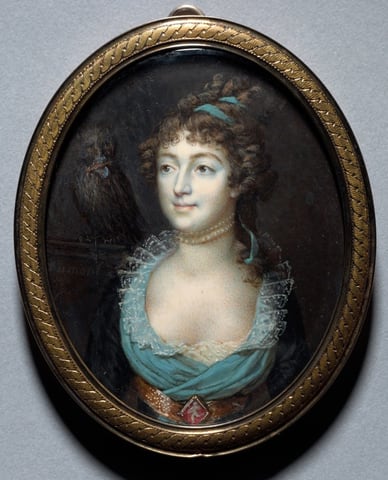
  3. Portrait of Mademoiselle Marie-Anne Adelaide Le Normand, by François Dumont, c. 1793
    Portrait of Mademoiselle Marie-Anne Adelaide Le NormandFrançois Dumont, c. 1793Courtesy of the Cleveland Museum of Art

Second room, north wall
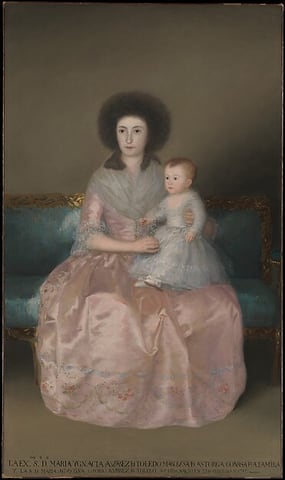
  1. Condesa de Altamira and Her Daughter, María Agustina, by Francisco Goya, 1787–88
    Condesa de Altamira and Her Daughter, María AgustinaFrancisco Goya, 1787–88Courtesy of The Metropolitan Museum of Art
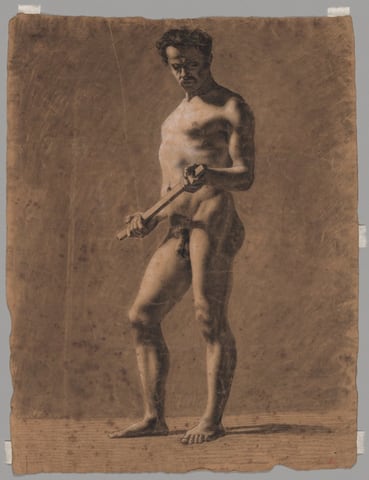
  2. A work made of black chalk and charcoal with stumping, heightened with white chalk (recto), and black chalk and charcoal with stumping (verso), on dark tan laid paper.
    Standing Academic Male Nude (recto); Sketch of Upper Arm (verso)Eugène Delacroix, 1816Courtesy of the Art Institute of Chicago
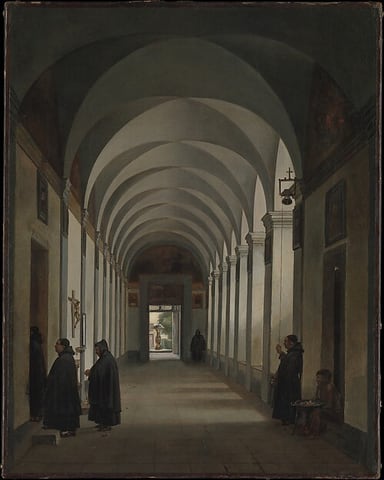
  3. Monks in the Cloister of the Church of Gesù e Maria, Rome, by François Marius Granet, 1808
    Monks in the Cloister of the Church of Gesù e Maria, RomeFrançois Marius Granet, 1808Courtesy of The Metropolitan Museum of Art

Third room, north wall
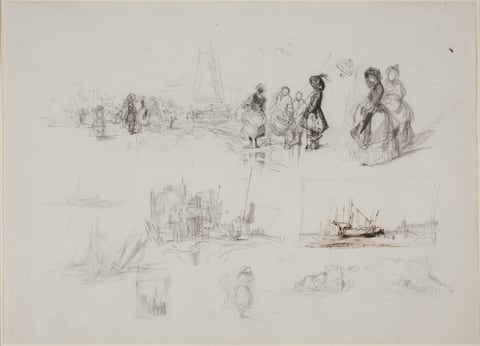
  1. This image is a pencil sketch on paper with a monochrome palette of graphite gray. The viewer sees various scenes without a defined horizon line. The upper section shows figures in period clothing, possibly mid-19th century women's fashion. The middle area has abstract architectural forms. In the lower right corner, a sailing ship or boat is sketched with more detail than the rest. The drawing style consists of quick, expressive strokes. The image conveys multiple narrative or compositional ideas on a single sheet.
    Seaside StudiesEugène Isabey, 1830sCourtesy National Gallery of Art, Washington
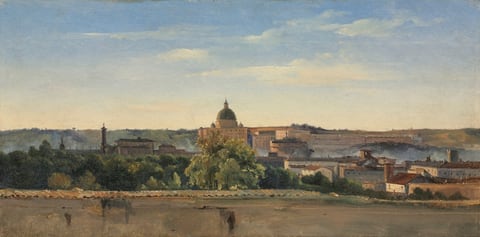
  2. View of Rome, by Pierre Henri de Valenciennes, c. 1782–84
    View of RomePierre Henri de Valenciennes, c. 1782–84Courtesy of the Cleveland Museum of Art
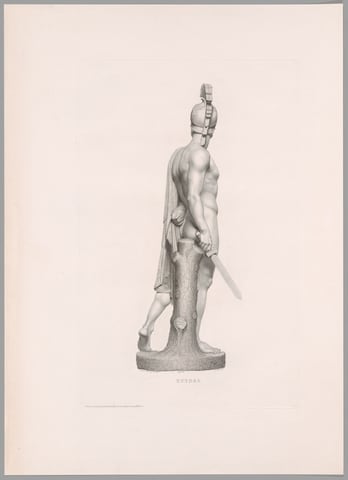
  3. A work made of engraving and etching in black on ivory wove paper.
    Ettore, Side View, from Oeuvre de CanovaAntonio Canova, 1817Courtesy of the Art Institute of Chicago
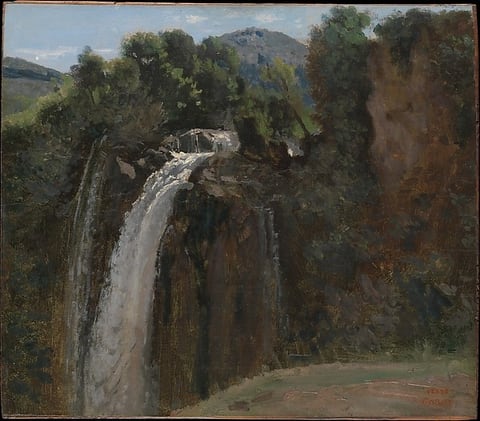
  4. Waterfall at Terni, by Jean Baptiste Camille Corot, 1826
    Waterfall at TerniJean Baptiste Camille Corot, 1826Courtesy of The Metropolitan Museum of Art

Walk on

  • Neoclassicism, room 2
  • More by Jean Baptiste Camille Corot 9 works
  • 19th-century France 237 works
Ochre Editions

The world's museums, on your wall. Every work here is a reproduction of a public-domain original, credited to the museum that holds it.

Shop

All artCollectionsLimited dropsPrints and framing

Help

Find an orderShippingReturnsVerify a certificate

About

About Ochre EditionsMuseum creditsFor agentsDevelopers

Legal

Terms of UseTerms of SaleLimited Editions and CertificatesPrivacy PolicyCookie PolicyAcceptable Use PolicyAgent & API TermsCopyright and DMCA PolicyPrinting Your Own PhotoVulnerability Disclosure PolicyAccessibility StatementOpen-Access Credits
© 2026 Ochre EditionsPrices in US dollars. Prints ship within the United States.
