


Floor plan

Style galleriesNeoclassicism

Neoclassicism

The image shows an illustration of a rocky terrain with towering stone formations and dense foliage. The sky is textured and the scene is created using an etching technique with intricate linework. There are two figures in the scene, one appearing to climb or position near a rock, while the other observes. The color palette is monochromatic, using black on a white background to depict depth and dimension in the artwork.
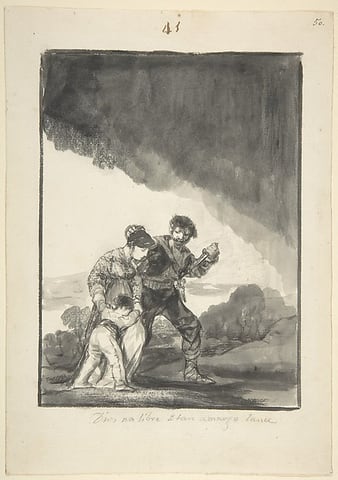
God save us from such a bitter fate; a bandit threatening a woman and a child with a knife, page 41 from the "Black Border Album" (E), by Francisco Goya, ca. 1816–20
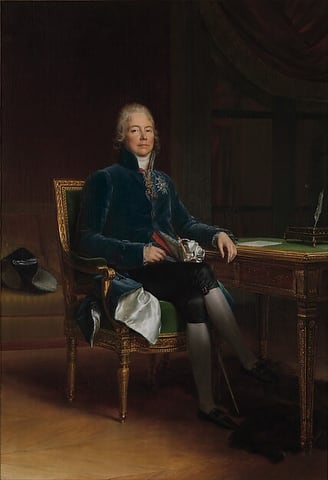
Charles Maurice de Talleyrand Périgord (1754–1838), Prince de Bénévent, by baron François Gérard, 1808
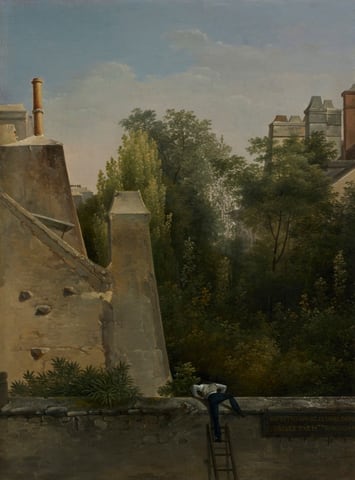
The Curious One, by Antoine Pierre Mongin, 1823
A work made of oil on panel.
The Antechamber of the Sala del Maggior Consiglio, by Francesco Guardi, ca. 1765–68
A work made of engraving and etching in black on ivory wove paper.
A work made of etching with roulette in black on ivory wove paper.

The works in this room are listed below.

Works in this room

Europe turns back to Greece and Rome: clear line, calm figures and civic virtue.

First room, north wall

  1. The image shows an illustration of a rocky terrain with towering stone formations and dense foliage. The sky is textured and the scene is created using an etching technique with intricate linework. There are two figures in the scene, one appearing to climb or position near a rock, while the other observes. The color palette is monochromatic, using black on a white background to depict depth and dimension in the artwork.
    Landscape with a Fallen Tree (Paysage à l'arbre cassé)Hubert Robert, 1764Courtesy National Gallery of Art, Washington
  2. God save us from such a bitter fate; a bandit threatening a woman and a child with a knife, page 41 from the "Black Border Album" (E), by Francisco Goya, ca. 1816–20
    God save us from such a bitter fate; a bandit threatening a woman and a child with a knife, page 41 from the "Black Border Album" (E)Francisco Goya, ca. 1816–20Courtesy of The Metropolitan Museum of Art
  3. Charles Maurice de Talleyrand Périgord (1754–1838), Prince de Bénévent, by baron François Gérard, 1808
    Charles Maurice de Talleyrand Périgord (1754–1838), Prince de Bénéventbaron François Gérard, 1808Courtesy of The Metropolitan Museum of Art
  4. The Curious One, by Antoine Pierre Mongin, 1823
    The Curious OneAntoine Pierre Mongin, 1823Courtesy of the Cleveland Museum of Art

First room, south wall

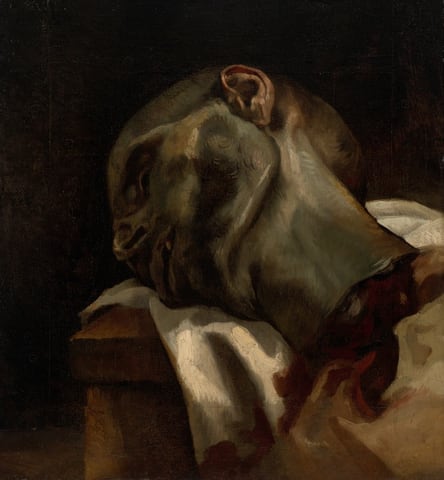
  1. A work made of oil on panel.
    Head of a Guillotined ManJean Louis André Théodore Géricault, 1818–19Courtesy of the Art Institute of Chicago
  2. The Antechamber of the Sala del Maggior Consiglio, by Francesco Guardi, ca. 1765–68
    The Antechamber of the Sala del Maggior ConsiglioFrancesco Guardi, ca. 1765–68Courtesy of The Metropolitan Museum of Art
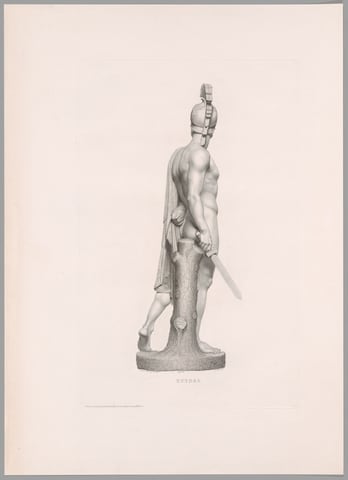
  3. A work made of engraving and etching in black on ivory wove paper.
    Ettore, Side View, from Oeuvre de CanovaAntonio Canova, 1817Courtesy of the Art Institute of Chicago
  4. A work made of etching with roulette in black on ivory wove paper.
    The Forest of RochecardonJean-Michel Grobon, 1800Courtesy of the Art Institute of Chicago

Second room, south wall
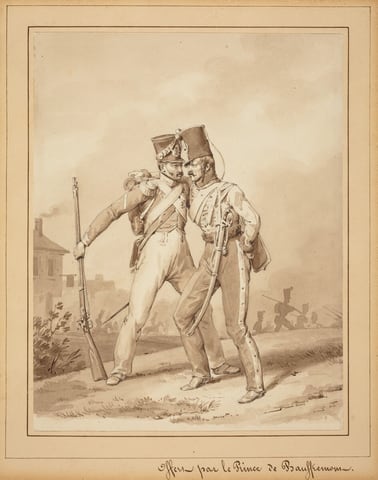
  1. The image features two men in military uniform engaging closely with each other. Both are shown from head to toe. The man on the left stands with his left leg forward, holding a rifle, and has his right arm around the shoulder of the other man. The man on the right has his right leg slightly bent, supporting his weight, and is holding a sword in his left hand. Each man has distinctive facial features. Both wear tall, elaborate military hats and detailed uniforms. The man on the left displays a strap over his shoulder, while the man on the right has intricate decorations on his jacket and trousers. In the background, there are a few more soldiers and part of a building to the left. The setting is monochromatic.
    Two GrenadiersVictor AdamCourtesy National Gallery of Art, Washington
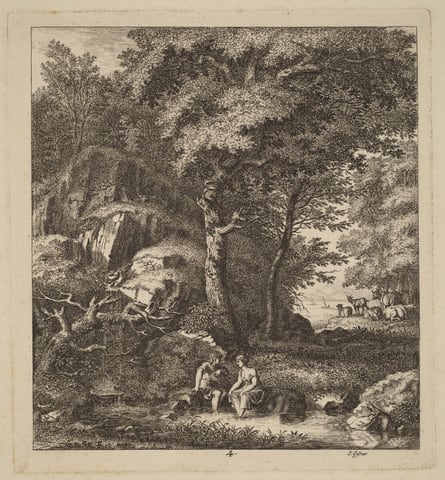
  2. The image depicts a forest scene with large trees dominating the right side, two figures seated by a stream, rocky formations on the left, grazing animals in the distance, and a monochrome color palette of brown and espresso tones.
    A Shepherd and a Young Woman With Their Feet in a BrookSalomon Gessner, 1764Courtesy National Gallery of Art, Washington
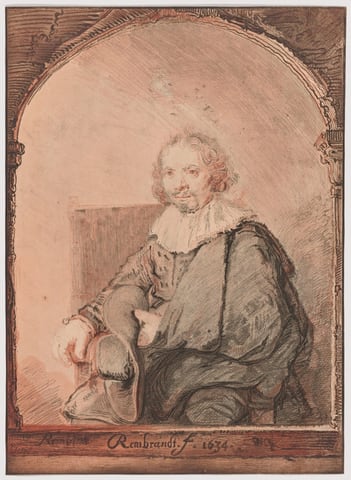
  3. A work made of soft ground etching, hard ground etching, aquatint, and roulette, printed from two plates in red-brown and black, on ivory laid paper.
    Portrait of a Man in an Armchair, from Collection d'imitations de Dessins d'après les Principaux Maîtres Hollandais et FlamandsChristian Josi, 1826Courtesy of the Art Institute of Chicago
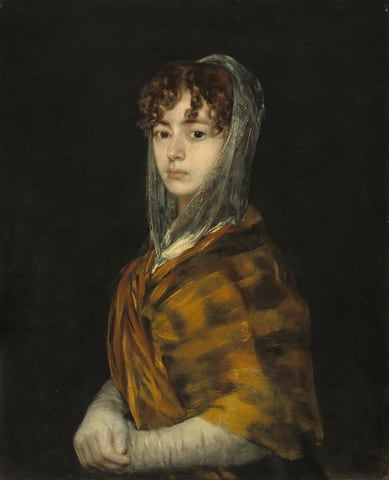
  4. Shown from the waist up in front of a black background, a young woman with pale white skin and curly brown hair looks directly out at us over her shoulder with her body angled to our left in this vertical portrait. She has dark brown eyes, a straight nose, smooth skin, and her pink lips are closed. Curls fall across her forehead but the rest of her hair is pulled up under a white lace scarf, called a mantilla. The mantilla is tucked under the wide orange and black shawl wrapped around her shoulders. She clasps her hands at her waist, and her hands and forearms are covered with long white gloves that disappear under the shawl.
    Señora Sabasa GarciaFrancisco Goya, c. 1806/1811Courtesy National Gallery of Art, Washington

Second room, north wall
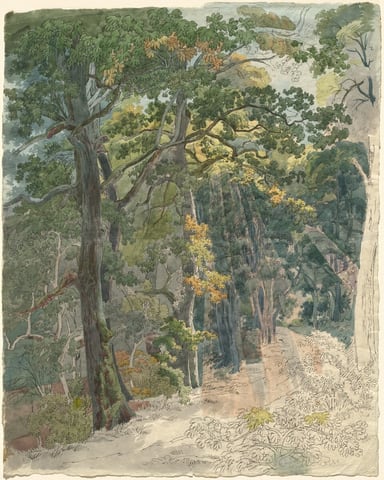
  1. The image shows a dense, forested area with towering trees. The composition leads the eye along a pathway into the distance, without a distinct horizon line. The intricate brushstrokes depict the texture and foliage of the trees, suggesting movement and light filtering through the leaves. The color palette is rich and earthy, with shades of green, brown, yellow, and orange, creating a vibrant yet tranquil atmosphere emphasizing light and shadow.
    Rays of Sunlight Striking a Woodland PathFriedrich Salathé, c. 1815Courtesy National Gallery of Art, Washington
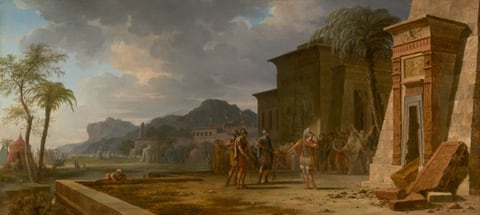
  2. A work made of oil on canvas.
    Alexander at the Tomb of Cyrus the GreatPierre Henri de Valenciennes, 1796Courtesy of the Art Institute of Chicago

Third room, north wall
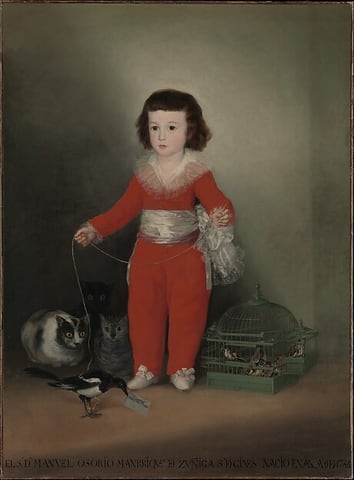
  1. Manuel Osorio Manrique de Zuñiga (1784–1792), by Francisco Goya, 1787–88
    Manuel Osorio Manrique de Zuñiga (1784–1792)Francisco Goya, 1787–88Courtesy of The Metropolitan Museum of Art
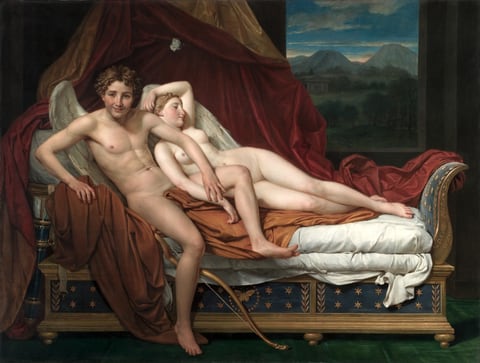
  2. Cupid and Psyche, by Jacques-Louis David, 1817
    Cupid and PsycheJacques-Louis David, 1817Courtesy of the Cleveland Museum of Art