
Floor plan

Style galleriesNeoclassicism

Neoclassicism

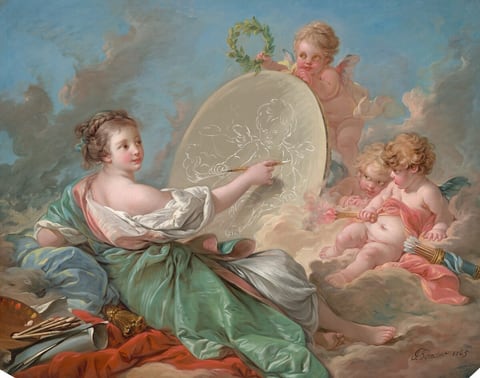
A young woman draws on an oval surface with white chalk while three winged, baby-like putti gather nearby, all on a bank of pale pink clouds in this horizontal painting. The woman and putti have pale, rosy skin, flushed cheeks, and hazel-brown eyes. To our left, the woman reclines with her upper body propped up on her far elbow, which rests on a steel-blue cushion as her legs stretch out to our right. Her light brown hair is braided and wrapped across the top of her head. She wears a loose, seafoam-green robe over a billowing ivory-white garment that has slipped off the shoulder closer to us. A round paint palette with brushes sticking out of its thumb hole and a roll of blue and white paper sit in the lower left corner, behind the woman. The woman and the objects are on a red cloth. In front of the woman is a rounded surface, perhaps a canvas, on which she draws. She holds up a gold-colored stylus with her right hand, closer to us, with a pointed piece of white chalk in one end and black chalk in the other. The canvas is taller than her head, so the child-like putto she draws on it is life-sized. The three nude putti on the far side of the canvas have copper or golden-blond, curly hair, flushed, rounded cheeks, short wings in white or peacock blue, pudgy torsos, and dimpled limbs. One putto, presumably the one the woman draws, sits back on the bank of clouds with a carnation-pink sash across his chest. He pulls his chin back and looks at her from under his eyebrows. He holds a gold-colored torch with a pink flame in one hand, and the other hand rests near a cylindrical quiver of arrows. Another putto peeks around the side of the canvas, and the third stands and props the canvas up. That third putto holds up a wreath of laurel leaves up over the canvas, above the woman’s drawing hand. The bank of clouds is parchment-brown with muted pink and blue highlights against a vivid blue sky. The artist signed and dated the lower right, “F Boucher – 1765.”
A work made of etching with roulette in black on ivory wove paper.
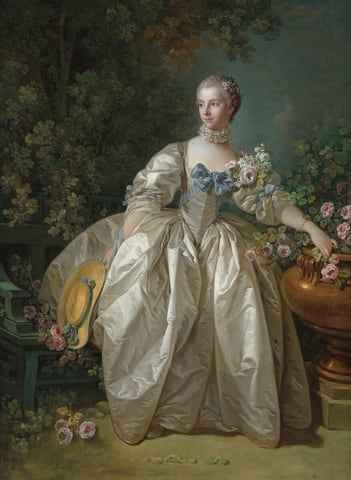
A young woman with light skin stands in a garden, wearing a voluminous, full-length, silvery, shimmering gown in this vertical portrait painting. Her body faces us, as she looks into the distance to our left. She has rosy cheeks, gray-green eyes under gently arched, light brown brows, and her coral-pink, thin, closed lips curve in a slight smile. Her ash-brown hair is pulled back and adorned with tiny shell-pink and azure-blue flowers along the left side top of head, to our right. A pleated lace ruffle encircles her smooth neck. Her gown is parchment white where the light glints off the stiff fabric and is silvery gray in the shadows, creating a silk-like sheen. The dress is cut low across the chest, fits tightly around her narrow waist, and has puffy sleeves tied at the elbows with topaz-blue bows. Another blue bow is tied at her chest, and the ends wrap around her back along her waist. A corsage at her left shoulder, to our right, is a profusion of white flowers around a pale pink rose. In her other hand, to our left, she holds a straw hat with a shallow crown and a wide brim, trimmed with sky-blue ribbon. The arm holding the hat is nearly engulfed in the deep folds of her full skirt. She holds a pink rose in her other hand, which rests on the lip of a shiny, copper-colored urn filled with pink flowers and delicate green leaves. On that wrist she wears a bracelet with four strands of white pearls holding a cameo. She stands on a pale, dirt ground. A teal-blue bench in the lower left corner of the painting is tucked into sage-green shrubbery. Sprigs of pink roses are strewn across the seat and on the ground. The woman is framed to either side with olive and celery-green trees and vegetation, which blend into the hazy distance beyond her head.
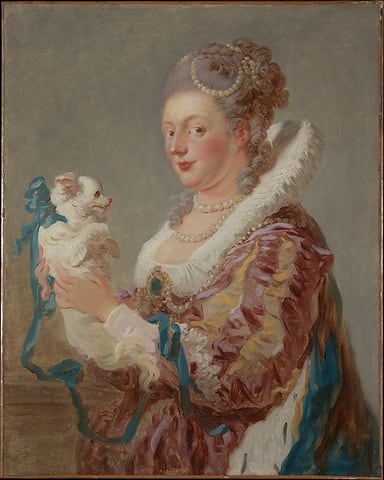
Marie Emilie Coignet de Courson (1716–1806) with a Dog, by Jean Honoré Fragonard, ca. 1769
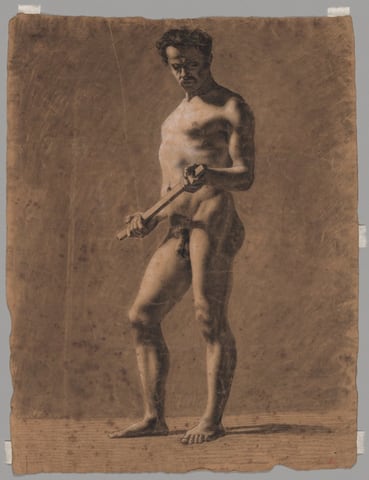
A work made of black chalk and charcoal with stumping, heightened with white chalk (recto), and black chalk and charcoal with stumping (verso), on dark tan laid paper.
A work made of conté crayon on gray-blue wove paper.
A work made of oil on panel.

The works in this room are listed below.

Works in this room

Europe turns back to Greece and Rome: clear line, calm figures and civic virtue.

First room, north wall

  1. A young woman draws on an oval surface with white chalk while three winged, baby-like putti gather nearby, all on a bank of pale pink clouds in this horizontal painting. The woman and putti have pale, rosy skin, flushed cheeks, and hazel-brown eyes. To our left, the woman reclines with her upper body propped up on her far elbow, which rests on a steel-blue cushion as her legs stretch out to our right. Her light brown hair is braided and wrapped across the top of her head. She wears a loose, seafoam-green robe over a billowing ivory-white garment that has slipped off the shoulder closer to us. A round paint palette with brushes sticking out of its thumb hole and a roll of blue and white paper sit in the lower left corner, behind the woman. The woman and the objects are on a red cloth. In front of the woman is a rounded surface, perhaps a canvas, on which she draws. She holds up a gold-colored stylus with her right hand, closer to us, with a pointed piece of white chalk in one end and black chalk in the other. The canvas is taller than her head, so the child-like putto she draws on it is life-sized. The three nude putti on the far side of the canvas have copper or golden-blond, curly hair, flushed, rounded cheeks, short wings in white or peacock blue, pudgy torsos, and dimpled limbs. One putto, presumably the one the woman draws, sits back on the bank of clouds with a carnation-pink sash across his chest. He pulls his chin back and looks at her from under his eyebrows. He holds a gold-colored torch with a pink flame in one hand, and the other hand rests near a cylindrical quiver of arrows. Another putto peeks around the side of the canvas, and the third stands and props the canvas up. That third putto holds up a wreath of laurel leaves up over the canvas, above the woman’s drawing hand. The bank of clouds is parchment-brown with muted pink and blue highlights against a vivid blue sky. The artist signed and dated the lower right, “F Boucher – 1765.”
    Allegory of PaintingFrançois Boucher, 1765Courtesy National Gallery of Art, Washington
  2. A work made of etching with roulette in black on ivory wove paper.
    The Forest of RochecardonJean-Michel Grobon, 1800Courtesy of the Art Institute of Chicago
  3. A young woman with light skin stands in a garden, wearing a voluminous, full-length, silvery, shimmering gown in this vertical portrait painting. Her body faces us, as she looks into the distance to our left. She has rosy cheeks, gray-green eyes under gently arched, light brown brows, and her coral-pink, thin, closed lips curve in a slight smile. Her ash-brown hair is pulled back and adorned with tiny shell-pink and azure-blue flowers along the left side top of head, to our right. A pleated lace ruffle encircles her smooth neck. Her gown is parchment white where the light glints off the stiff fabric and is silvery gray in the shadows, creating a silk-like sheen. The dress is cut low across the chest, fits tightly around her narrow waist, and has puffy sleeves tied at the elbows with topaz-blue bows. Another blue bow is tied at her chest, and the ends wrap around her back along her waist. A corsage at her left shoulder, to our right, is a profusion of white flowers around a pale pink rose. In her other hand, to our left, she holds a straw hat with a shallow crown and a wide brim, trimmed with sky-blue ribbon. The arm holding the hat is nearly engulfed in the deep folds of her full skirt. She holds a pink rose in her other hand, which rests on the lip of a shiny, copper-colored urn filled with pink flowers and delicate green leaves. On that wrist she wears a bracelet with four strands of white pearls holding a cameo. She stands on a pale, dirt ground. A teal-blue bench in the lower left corner of the painting is tucked into sage-green shrubbery. Sprigs of pink roses are strewn across the seat and on the ground. The woman is framed to either side with olive and celery-green trees and vegetation, which blend into the hazy distance beyond her head.
    Madame BergeretFrançois Boucher, possibly 1766Courtesy National Gallery of Art, Washington

First room, south wall

  1. Marie Emilie Coignet de Courson (1716–1806) with a Dog, by Jean Honoré Fragonard, ca. 1769
    Marie Emilie Coignet de Courson (1716–1806) with a DogJean Honoré Fragonard, ca. 1769Courtesy of The Metropolitan Museum of Art
  2. A work made of black chalk and charcoal with stumping, heightened with white chalk (recto), and black chalk and charcoal with stumping (verso), on dark tan laid paper.
    Standing Academic Male Nude (recto); Sketch of Upper Arm (verso)Eugène Delacroix, 1816Courtesy of the Art Institute of Chicago
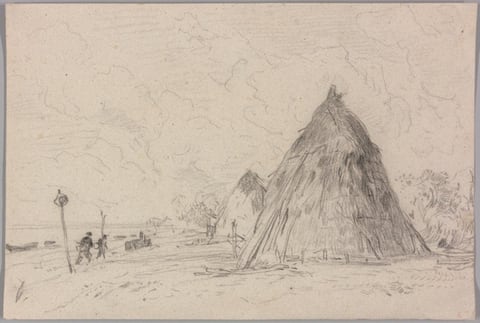
  3. A work made of conté crayon on gray-blue wove paper.
    Landscape with HaystacksConstant Troyon, n.d.Courtesy of the Art Institute of Chicago
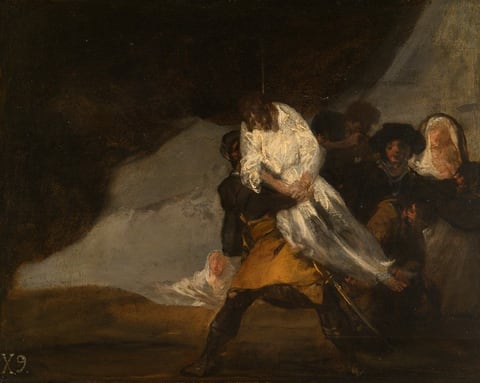
  4. A work made of oil on panel.
    The Hanged MonkFrancisco Goya, c. 1810Courtesy of the Art Institute of Chicago

Second room, south wall
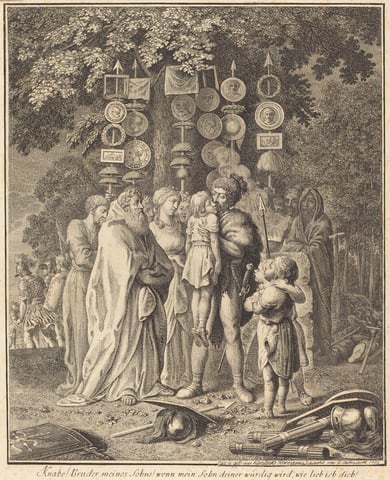
  1. The image depicts a group of people in varying poses and outfits. A central figure, possibly a child, is being held up by a man. Those around them are positioned differently, some standing closely. The figures have detailed faces and wear garments resembling classical attire. Shields and banners decorated with symbols are present in the background. Armor and helmets are scattered on the ground. Trees and a group of people in the distance are part of the background.
    Ancient TeutonsDaniel Nikolaus Chodowiecki, 1782Courtesy National Gallery of Art, Washington
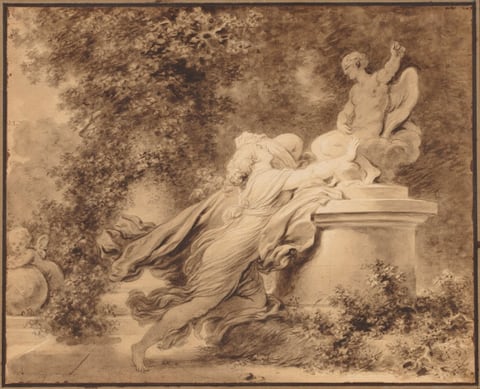
  2. Invocation to Love, by Jean Honoré Fragonard, c. 1781
    Invocation to LoveJean Honoré Fragonard, c. 1781Courtesy of the Cleveland Museum of Art

  3. The Antechamber of the Sala del Maggior Consiglio, by Francesco Guardi, ca. 1765–68
    The Antechamber of the Sala del Maggior ConsiglioFrancesco Guardi, ca. 1765–68Courtesy of The Metropolitan Museum of Art
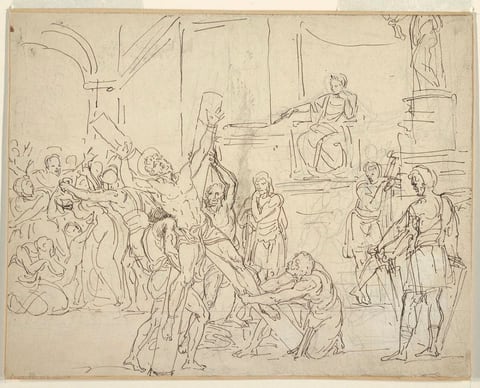
  4. MARTYRDOM OF ST. ANDREW
    Martyrdom of St. AndrewFrancesco Coghetti, 1825–50Courtesy of Cooper Hewitt, Smithsonian Design Museum

Second room, north wall
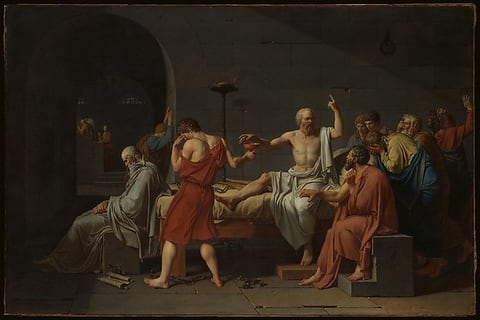
  1. The Death of Socrates, by Jacques-Louis David, 1787
    The Death of SocratesJacques-Louis David, 1787Courtesy of The Metropolitan Museum of Art
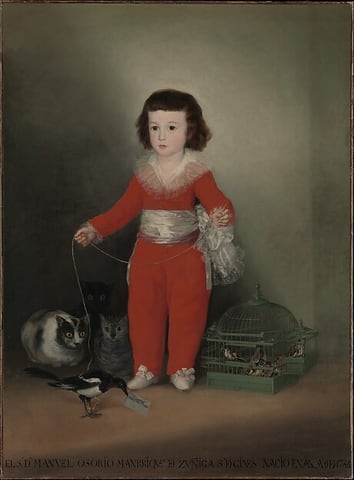
  2. Manuel Osorio Manrique de Zuñiga (1784–1792), by Francisco Goya, 1787–88
    Manuel Osorio Manrique de Zuñiga (1784–1792)Francisco Goya, 1787–88Courtesy of The Metropolitan Museum of Art
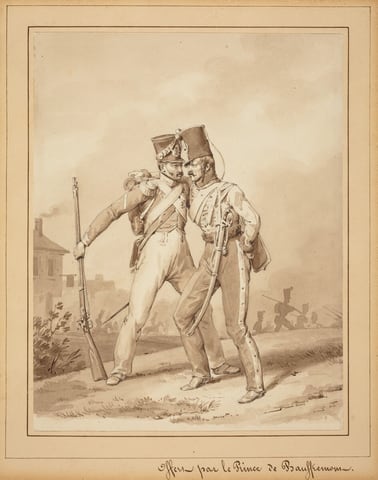
  3. The image features two men in military uniform engaging closely with each other. Both are shown from head to toe. The man on the left stands with his left leg forward, holding a rifle, and has his right arm around the shoulder of the other man. The man on the right has his right leg slightly bent, supporting his weight, and is holding a sword in his left hand. Each man has distinctive facial features. Both wear tall, elaborate military hats and detailed uniforms. The man on the left displays a strap over his shoulder, while the man on the right has intricate decorations on his jacket and trousers. In the background, there are a few more soldiers and part of a building to the left. The setting is monochromatic.
    Two GrenadiersVictor AdamCourtesy National Gallery of Art, Washington

Third room, north wall
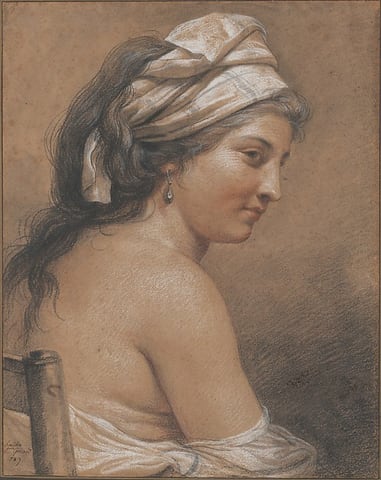
  1. Study of a Seated Woman Seen from Behind (Marie-Gabrielle Capet), by Adélaïde Labille-Guiard, 1789
    Study of a Seated Woman Seen from Behind (Marie-Gabrielle Capet)Adélaïde Labille-Guiard, 1789Courtesy of The Metropolitan Museum of Art
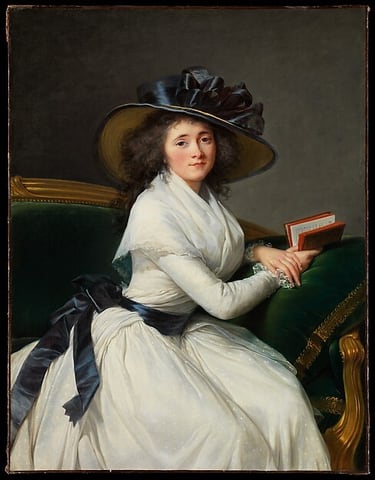
  2. Comtesse de la Châtre (Marie Charlotte Louise Perrette Aglaé Bontemps, 1762–1848), by Elisabeth Louise Vigée Le Brun, 1789
    Comtesse de la Châtre (Marie Charlotte Louise Perrette Aglaé Bontemps, 1762–1848)Elisabeth Louise Vigée Le Brun, 1789Courtesy of The Metropolitan Museum of Art