Skip to content
Ochre Editions
ArtArtistsCollectionsGalleriesDrops
SearchSign inCart (0)
The galleries · Style galleries

Neoclassicism

Europe turns back to Greece and Rome: clear line, calm figures and civic virtue.

109 works · hang 9962 ·

Share Neoclassicism, in the galleries

The rooms are imagined; every work on their walls is real.

Walk this roomRehang this room

First room, north wall

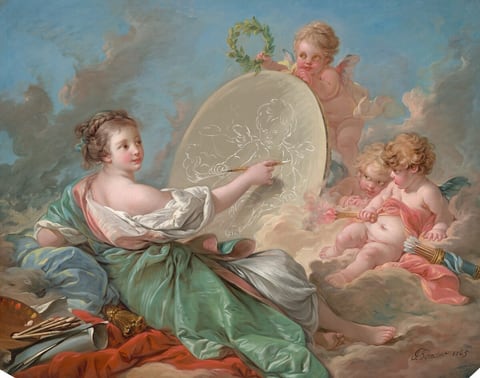
  1. A young woman draws on an oval surface with white chalk while three winged, baby-like putti gather nearby, all on a bank of pale pink clouds in this horizontal painting. The woman and putti have pale, rosy skin, flushed cheeks, and hazel-brown eyes. To our left, the woman reclines with her upper body propped up on her far elbow, which rests on a steel-blue cushion as her legs stretch out to our right. Her light brown hair is braided and wrapped across the top of her head. She wears a loose, seafoam-green robe over a billowing ivory-white garment that has slipped off the shoulder closer to us. A round paint palette with brushes sticking out of its thumb hole and a roll of blue and white paper sit in the lower left corner, behind the woman. The woman and the objects are on a red cloth. In front of the woman is a rounded surface, perhaps a canvas, on which she draws. She holds up a gold-colored stylus with her right hand, closer to us, with a pointed piece of white chalk in one end and black chalk in the other. The canvas is taller than her head, so the child-like putto she draws on it is life-sized. The three nude putti on the far side of the canvas have copper or golden-blond, curly hair, flushed, rounded cheeks, short wings in white or peacock blue, pudgy torsos, and dimpled limbs. One putto, presumably the one the woman draws, sits back on the bank of clouds with a carnation-pink sash across his chest. He pulls his chin back and looks at her from under his eyebrows. He holds a gold-colored torch with a pink flame in one hand, and the other hand rests near a cylindrical quiver of arrows. Another putto peeks around the side of the canvas, and the third stands and props the canvas up. That third putto holds up a wreath of laurel leaves up over the canvas, above the woman’s drawing hand. The bank of clouds is parchment-brown with muted pink and blue highlights against a vivid blue sky. The artist signed and dated the lower right, “F Boucher – 1765.”
    Allegory of PaintingFrançois Boucher, 1765Courtesy National Gallery of Art, Washington
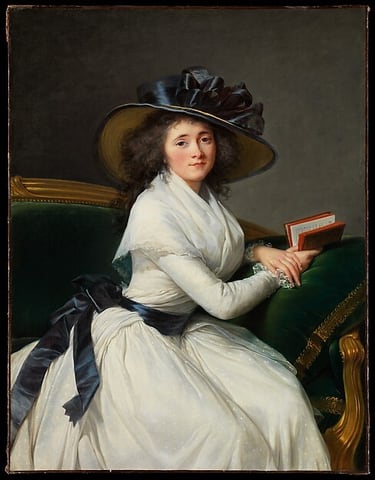
  2. Comtesse de la Châtre (Marie Charlotte Louise Perrette Aglaé Bontemps, 1762–1848), by Elisabeth Louise Vigée Le Brun, 1789
    Comtesse de la Châtre (Marie Charlotte Louise Perrette Aglaé Bontemps, 1762–1848)Elisabeth Louise Vigée Le Brun, 1789Courtesy of The Metropolitan Museum of Art

First room, south wall
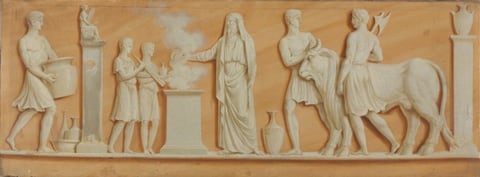
  1. Overdoor Painting, by Pierre Rousseau, 1790s
    Overdoor PaintingPierre Rousseau, 1790sCourtesy of the Cleveland Museum of Art
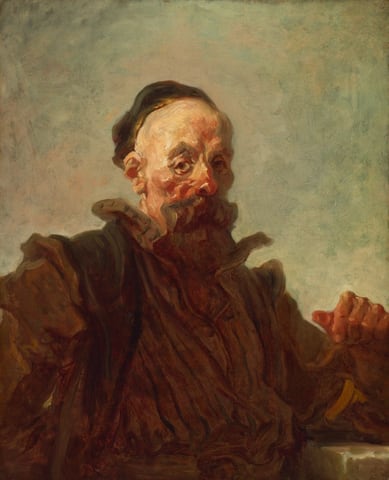
  2. Painting of bearded, ruddy-faced man in eighteenth century style clothing.
    Portrait of a Man in CostumeJean Honoré Fragonard, c. 1767–68Courtesy of the Art Institute of Chicago
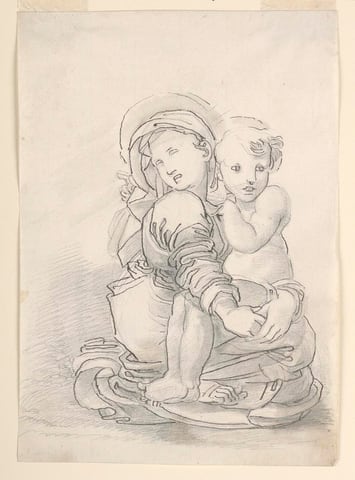
  3. THE VIRGIN WITH THE CHILD
    The Virgin with the ChildFortunato Duranti, 1820–1850Courtesy of Cooper Hewitt, Smithsonian Design Museum

Second room, south wall
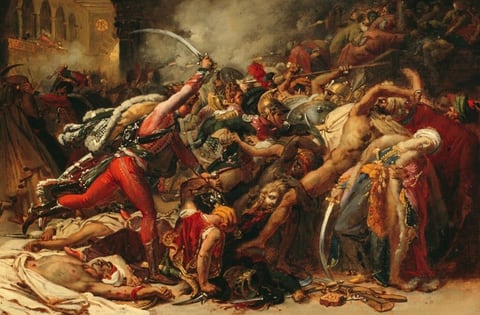
  1. A work made of oil and ink on paper, laid down on canvas.
    Sketch for The Revolt of CairoAnne-Louis Girodet de Roussy-Trioson, c. 1810Courtesy of the Art Institute of Chicago

  2. The image shows three figures. Two of them are embracing in the foreground, kneeling on the ground and facing each other in a kiss. The person on the left has curly hair and appears to be wearing a coat-like garment, while the person on the right has long hair tied back and is dressed in a long robe. The third figure emerges from the bushes in the background, with shoulder-length hair, wearing a dress with a sash and a light shawl or scarf over their head. The setting includes tall trees, shrubs, and a structure with columns and arches on the right side, suggesting a garden or courtyard. Rolling hills and cloudy skies are in the distant background.
    The Fortunate RescueDaniel Nikolaus Chodowiecki, 1791Courtesy National Gallery of Art, Washington
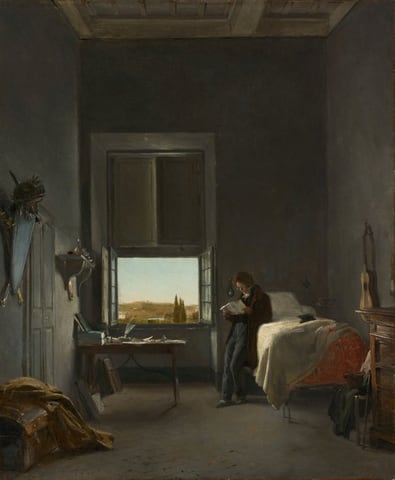
  3. The Artist in His Room at the Villa Medici, Rome, by Léon Cogniet, 1817
    The Artist in His Room at the Villa Medici, RomeLéon Cogniet, 1817Courtesy of the Cleveland Museum of Art
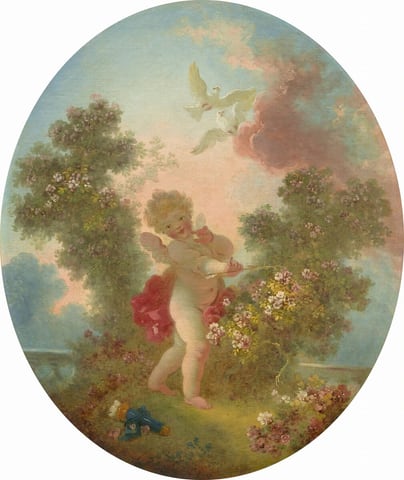
  4. This oval painting depicts a cherubic child in a garden setting. The child is standing with one foot in front of the other and has small wings on their back. The child has light skin, curly blond hair, rosy cheeks, and a playful expression. They are mostly nude, except for a cloth that wraps around their back and covers their groin. The child is holding a golden arrow. They are standing in front of a light green bush with pink flowers. In the bottom left, there is a dark blue object in the green grass that looks like a torch or cylindrical quiver. The setting includes lush greenery and more clusters of pink and white flowers. The background features a pastel blue sky with soft pink clouds and two white doves flying above.
    Love the SentinelJean Honoré Fragonard, c. 1773/1776Courtesy National Gallery of Art, Washington

Second room, north wall
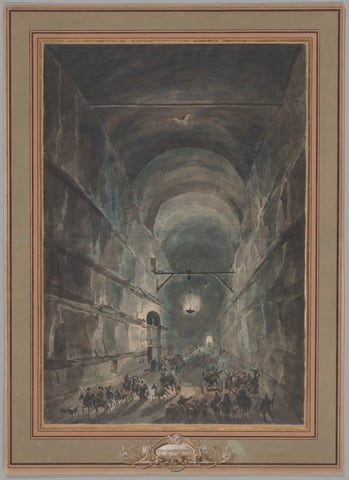
  1. A work made of handcolored etching in black on cream laid paper.
    The Grotto of Posillipo (La Grotta di Posillipo)Louis Jean Desprez, 1785/90Courtesy of the Art Institute of Chicago
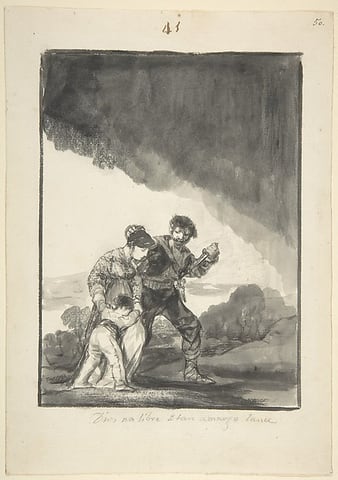
  2. God save us from such a bitter fate; a bandit threatening a woman and a child with a knife, page 41 from the "Black Border Album" (E), by Francisco Goya, ca. 1816–20
    God save us from such a bitter fate; a bandit threatening a woman and a child with a knife, page 41 from the "Black Border Album" (E)Francisco Goya, ca. 1816–20Courtesy of The Metropolitan Museum of Art
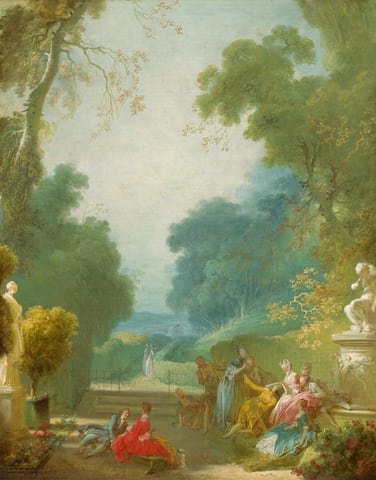
  3. Towering, pale, celery-green trees frame a view of a lush park with about a dozen elegantly dressed, light-skinned men and women in this vertical landscape painting. The color palette is dominated by moss and lemon-lime green, golden yellow, and spruce blue. The men all wear jackets with long tails over knee-breeches, and their long hair is pulled back at the napes of their necks. The women wear long dresses with full skirts and hints of lace at the sleeves and bust, and their brown or white hair is pulled up. Nine of the men and women gather to our right on a stone terrace along the bottom edge of the painting. A man in butter yellow kneels in front of a woman wearing rose pink. Around this pair, people stand, kneel, sit, or recline wearing aquamarine blue, light turquoise, or ivory white. A man and woman sit on a bench to our left, a little removed from the larger group. This woman wears ruby red and the man leaning toward her wears topaz blue. Two people in the park beyond these groups are painted with only a few strokes of pale blue and white paint, and they look over a low hedge row lining the walking path. Beds of red flowers fill the lower corners of the composition in front of a statue of a woman to our left and a person, perhaps on a fountain, to our right. The grassy walking path and trees become more blue as they fade into the hazy distance between the tall tress to either side. The sky fades from pale blue along the horizon to a silvery blue, almost white, at the top.
    A Game of Hot CocklesJean Honoré Fragonard, c. 1775/1780Courtesy National Gallery of Art, Washington

Third room, north wall
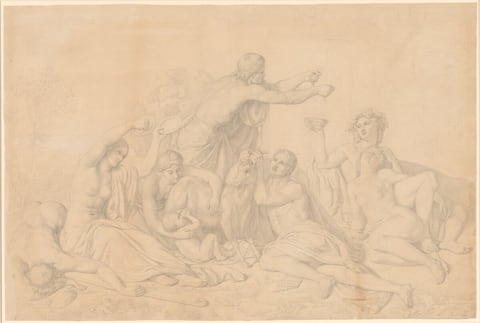
  1. This is a drawing of a group of mythological figures in a ceremonial scene. The composition features multiple figures in various poses, centered around a symbolic gathering. The drawing is detailed, providing a classical representation of human forms, draped fabrics, and an animal. A plateau with trees is subtly depicted in the background. The figures display expressions ranging from serene to contemplative.
    The Nursing of JupiterThéodore ChassériauCourtesy National Gallery of Art, Washington
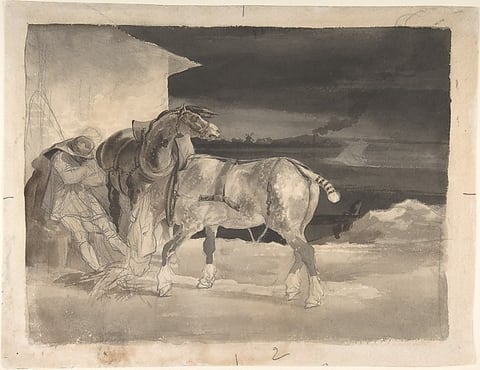
  2. Two Draft Horses with a Sleeping Driver, by Jean Louis André Théodore Géricault, 1820–22
    Two Draft Horses with a Sleeping DriverJean Louis André Théodore Géricault, 1820–22Courtesy of The Metropolitan Museum of Art
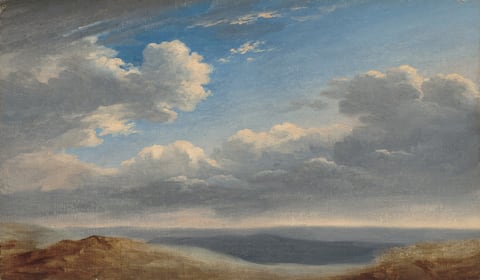
  3. A sliver of land across the bottom of this composition gives way to a procession of puffy gray and white clouds sweeping up across a vivid blue, panoramic sky in this horizontal landscape painting. An area of darker gray beyond the brown land could be a valley, mountain, or shadows from the billowing clouds. About one-fifth of the way up the composition, the horizon glows the faintest peach. The clouds trundle from our left up and to our right. The view is loosely painted, especially in the land.
    Study of Clouds over the Roman CampagnaPierre Henri de Valenciennes, c. 1782/1785Courtesy National Gallery of Art, Washington
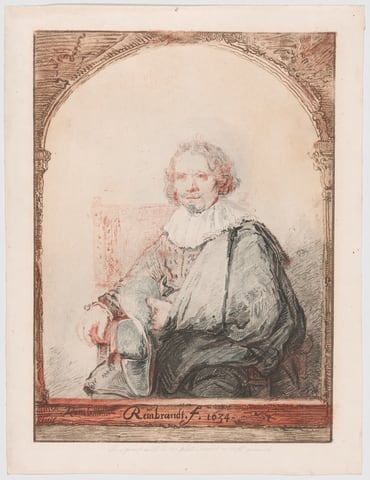
  4. A work made of soft ground etching from two plates, with roulette, on paper.
    Portrait of a Man in an Armchair, from Collection d'imitations de Dessins d'après les Principaux Maîtres Hollandais et FlamandsChristian Josi, 1826Courtesy of the Art Institute of Chicago

Walk on

  • Neoclassicism, room 2
  • More by Christian Josi 3 works
  • 19th-century Netherlands 21 works
Ochre Editions

The world's museums, on your wall. Every work here is a reproduction of a public-domain original, credited to the museum that holds it.

Shop

All artCollectionsLimited dropsPrints and framing

Help

Find an orderShippingReturnsVerify a certificate

About

About Ochre EditionsMuseum creditsFor agentsDevelopers

Legal

Terms of UseTerms of SaleLimited Editions and CertificatesPrivacy PolicyCookie PolicyAcceptable Use PolicyAgent & API TermsCopyright and DMCA PolicyPrinting Your Own PhotoVulnerability Disclosure PolicyAccessibility StatementOpen-Access Credits
© 2026 Ochre EditionsPrices in US dollars. Prints ship within the United States.