Floor plan

Style galleriesThe Northern Renaissance
The Northern Renaissance
Saint John on Patmos, by Hans Baldung (called Hans Baldung Grien), ca. 1511
TWO GALLEYS AT SEA
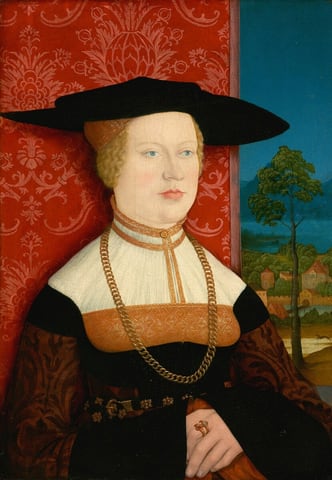
Shown from the waist up, a light-skinned woman sits angled slightly to our right in this vertical portrait painting. The woman has blue eyes, faint brows, and a sloping nose ending in a small bulb. Her upper lip is thin and her lower lip full over a slight double chin. Her blond hair is pulled back under a gold, cap-like headdress and a black, wide-brimmed hat with a shallow crown. She wears a high-necked white, black, and gold dress with intricate detailing, a gold chain necklace that falls to her waist, and a black belt with a gold clasp and medallions. She wears two gold rings set with gems on the pointer finger of her left hand, which is folded across her belly over the other hand. A scarlet-red wallcovering with pink floral designs fills two-thirds of the space behind her. The rightmost third of the background opens onto a landscape with a tall, spindly tree, a leaping animal, presumably a dog, and a bridge across a body of water leading to a town. Across another body of water, perhaps a lake, mountains are marine blue in the distance under a clear, celestial-blue sky.
This painting shows a man from the waist up. He is facing forward and gazes out at us. He has fair skin, light brown hair, a thin mustache and beard, and light green eyes. His expression is mostly neutral, although his peach lips are slightly turned up at the edges. He is wearing a black garment with a high collar and a hood and a black flat cap on his head. The background is plain blue, fading to black around the edges of the painting.
Christ Carrying the Cross, by Martin Schongauer, ca. 1475–80

The works in this room are listed below.

Works in this room

Dürer's prints, Holbein's portraits and the art of northern Europe in the 1500s.

Section 1, north wall

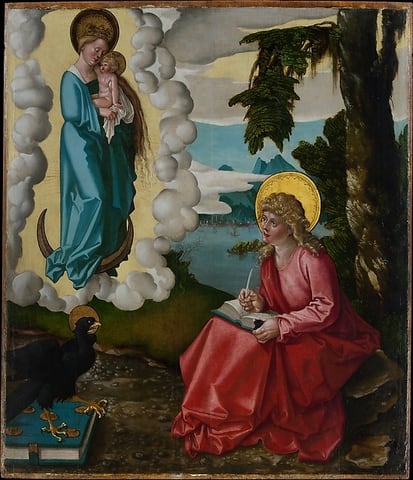
  1. Saint John on Patmos, by Hans Baldung (called Hans Baldung Grien), ca. 1511
    Saint John on PatmosHans Baldung (called Hans Baldung Grien), ca. 1511Courtesy of The Metropolitan Museum of Art
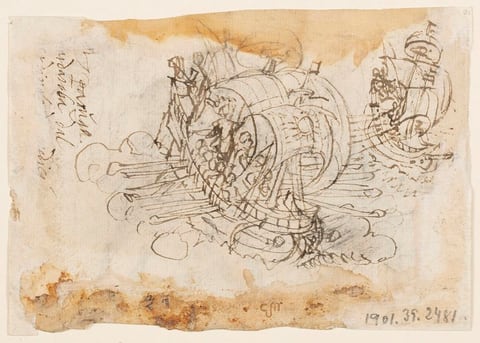
  2. TWO GALLEYS AT SEA
    Two Galleys at SeaJan van der Straet, called Stradanus, ca. 1587 – 1590Courtesy of Cooper Hewitt, Smithsonian Design Museum

Section 1, south wall

  1. Shown from the waist up, a light-skinned woman sits angled slightly to our right in this vertical portrait painting. The woman has blue eyes, faint brows, and a sloping nose ending in a small bulb. Her upper lip is thin and her lower lip full over a slight double chin. Her blond hair is pulled back under a gold, cap-like headdress and a black, wide-brimmed hat with a shallow crown. She wears a high-necked white, black, and gold dress with intricate detailing, a gold chain necklace that falls to her waist, and a black belt with a gold clasp and medallions. She wears two gold rings set with gems on the pointer finger of her left hand, which is folded across her belly over the other hand. A scarlet-red wallcovering with pink floral designs fills two-thirds of the space behind her. The rightmost third of the background opens onto a landscape with a tall, spindly tree, a leaping animal, presumably a dog, and a bridge across a body of water leading to a town. Across another body of water, perhaps a lake, mountains are marine blue in the distance under a clear, celestial-blue sky.
    Margarethe Vöhlin [obverse]Bernhard Strigel, 1527Courtesy National Gallery of Art, Washington
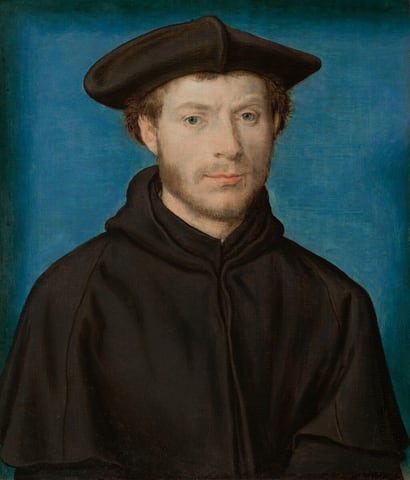
  2. This painting shows a man from the waist up. He is facing forward and gazes out at us. He has fair skin, light brown hair, a thin mustache and beard, and light green eyes. His expression is mostly neutral, although his peach lips are slightly turned up at the edges. He is wearing a black garment with a high collar and a hood and a black flat cap on his head. The background is plain blue, fading to black around the edges of the painting.
    Portrait of a ManCorneille de Lyon, c. 1536/1540Courtesy National Gallery of Art, Washington
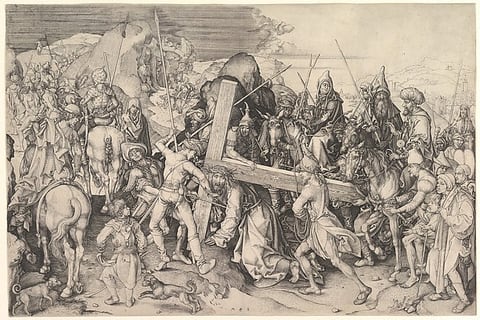
  3. Christ Carrying the Cross, by Martin Schongauer, ca. 1475–80
    Christ Carrying the CrossMartin Schongauer, ca. 1475–80Courtesy of The Metropolitan Museum of Art

Section 2, south wall
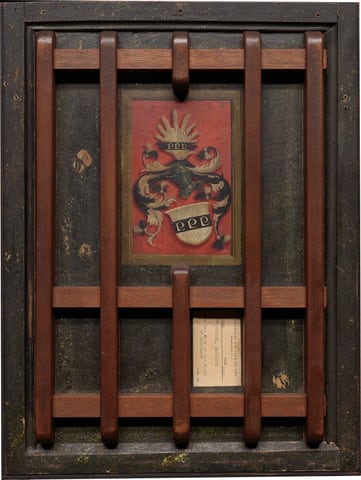
  1. The image shows a pattern of vertical and horizontal wooden bars forming a grid-like design. In the center, there is a rectangular panel with a decorative emblem against a red background. The emblem features swirling shapes. The structured wooden grid and ornate emblem suggest a vintage heraldic shield or coat of arms.
    Margarethe Vöhlin [reverse]Bernhard Strigel, 1527Courtesy National Gallery of Art, Washington
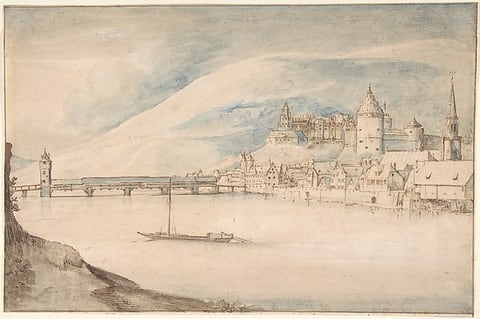
  2. View of Heidelberg, by Jan Brueghel the Elder, ca. 1588–89
    View of HeidelbergJan Brueghel the Elder, ca. 1588–89Courtesy of The Metropolitan Museum of Art
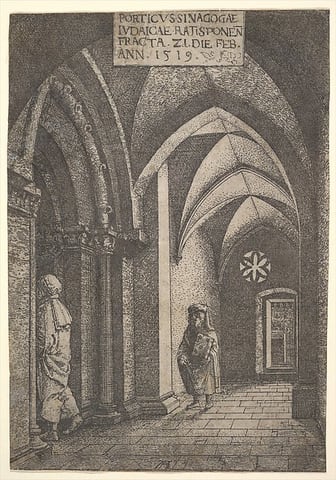
  3. The Entrance Hall of the Regensburg Synagogue, by Albrecht Altdorfer, 1519
    The Entrance Hall of the Regensburg SynagogueAlbrecht Altdorfer, 1519Courtesy of The Metropolitan Museum of Art

Section 2, north wall
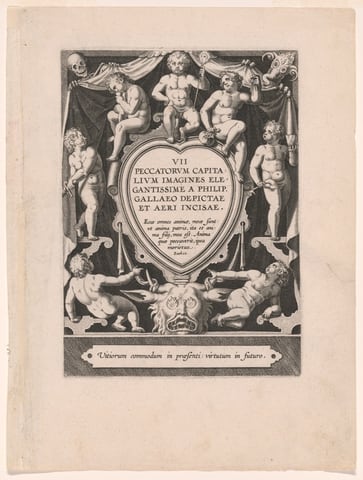
  1. A work made of engraving on paper.
    Title page, from The Seven VicesHieronymous Wierix, c. 1598Courtesy of the Art Institute of Chicago
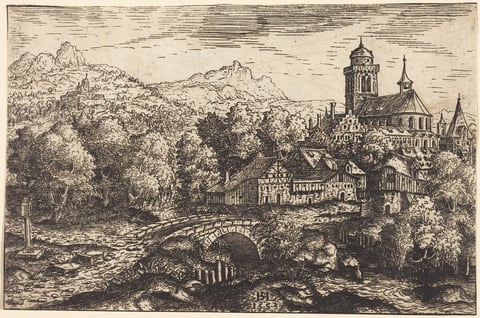
  2. The image features a landscape view of a medieval village scene. It includes a stone bridge over a river, buildings, a church with a tower, trees, hills, mountains, and cloudy sky. The image is depicted in intricate detail using a monochromatic palette, focusing on contrasts of light and shadow.
    Mountainous Landscape with a VillageHanns Lautensack, 1553Courtesy National Gallery of Art, Washington

Section 3, north wall
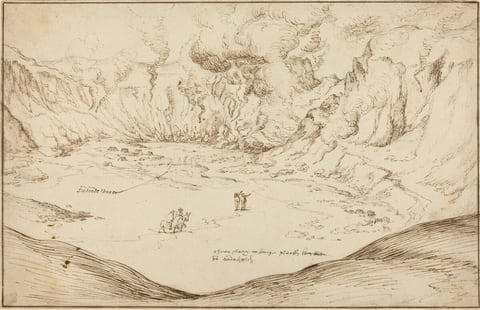
  1. The image shows an elevated view looking down into a crater-like landscape with steep surrounding cliffs. The horizon is high in the image, obscured by rocky formations and rising plumes of smoke. The detailed drawing has a sketch-like quality with fine lines depicting the cliffs and swirling smoke. The color palette is monochromatic, using shades of brown and beige. Two figures and a horse stand on a sloped terrain, providing scale. The crater's basin is visible, with smoke plumes and rock formations in the distance, stretching towards the horizon.
    Forum Vulcani: The Hot Springs at PozzuoliJoris Hoefnagel, 1578Courtesy National Gallery of Art, Washington
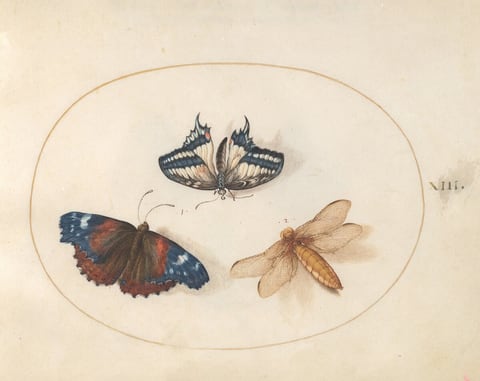
  2. Three insects are depicted in the image: a butterfly with dark blue and red wings on the bottom left, a larger butterfly with white, black, and blue patterns at the top center, and a dragonfly with brown and gold tones on the bottom right. The color palette includes rich blues, reds, browns, and golds against a neutral background. The central butterfly is positioned higher than the other two insects, with the left butterfly and right dragonfly symmetrically arranged below.
    Plate 13: Yellow Swallowtail and Red Admiral Butterflies with a Dragonfly (Broad-Bodied Chaser?)Joris Hoefnagel, c.1575/1590sCourtesy National Gallery of Art, Washington
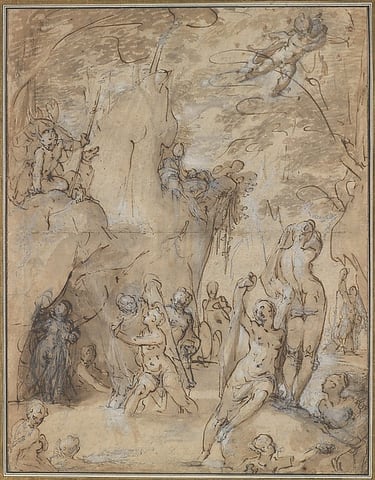
  3. Diana and Actaeon, by Bartholomeus Spranger, ca. 1580–85
    Diana and ActaeonBartholomeus Spranger, ca. 1580–85Courtesy of The Metropolitan Museum of Art

Section 3, south wall
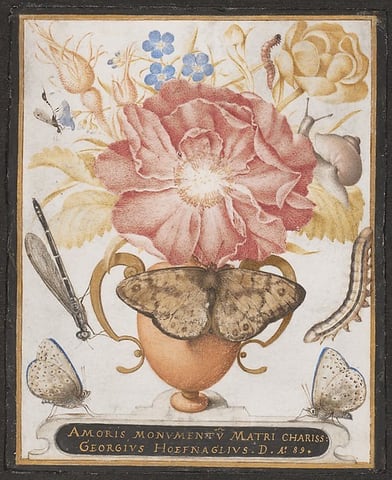
  1. Still Life with Flowers, a Snail and Insects, by Joris Hoefnagel, 1589
    Still Life with Flowers, a Snail and InsectsJoris Hoefnagel, 1589Courtesy of The Metropolitan Museum of Art
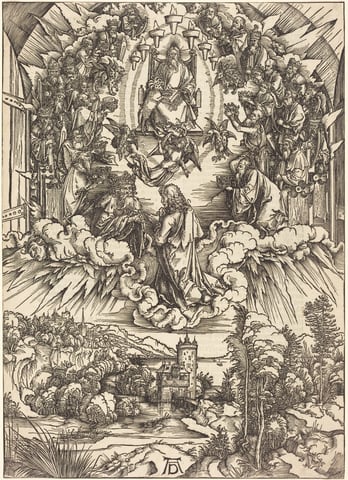
  2. The image features a celestial scene with multiple figures depicted from head to waist. Two central figures are engaged in a conversation amidst clouds. One figure appears seated, possibly on a throne, holding a book. Both figures have long hair and beards. The robes worn by the figures are detailed. Other figures surround them in a semi-circle, some wearing crowns, holding items like bowls. Heavenly hosts with wings are seen above. The background shows a detailed landscape with trees, a river, and castles nestled in hills.
    Saint John before God and the EldersAlbrecht Dürer, probably c. 1496/1498Courtesy National Gallery of Art, Washington
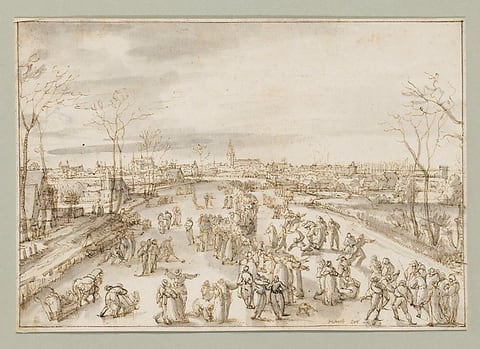
  3. Ice skaters on the Amstel in Amsterdam, by Hans Bol, 1589
    Ice skaters on the Amstel in AmsterdamHans Bol, 1589Courtesy of The Metropolitan Museum of Art