Floor plan

Style galleriesPrints of the 17th century
Prints of the 17th century
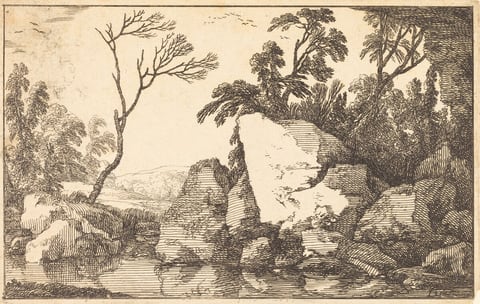
The image shows a landscape with trees, rocks, and water. The perspective is slightly elevated. Rocks are prominent in the central area, with various shapes and textures. Trees and foliage are depicted with detailed brushstrokes. The color scheme is sepia, creating a warm and vintage atmosphere. The scene includes water reflecting rocks, distant hills, and faint cloud formations.
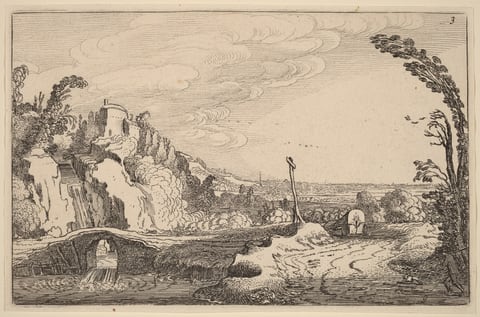
The image shows a pastoral scene in black and white with fine line work. A small bridge with a circular archway crosses a stream. A dirt path winds through the landscape flanked by grass and bushes. A rocky cliff ascends on the left with a tower-like structure partially obscured by vegetation. The horizon features a cloudy sky, with swirling lines indicating motion. In the distance, a tall, thin structure, possibly a spire or chimney, stands amid faint hills and trees. The scene conveys a serene atmosphere through hatching and cross-hatching techniques.
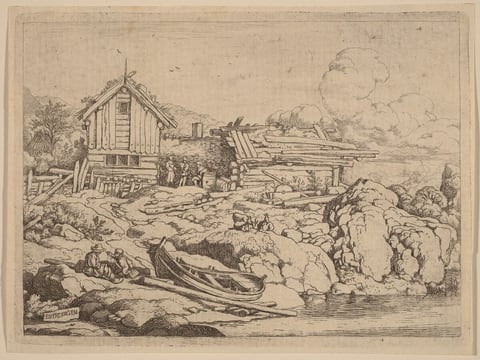
The image shows a landscape with figures near a body of water. There are buildings made of logs, people gathered near a structure, and trees in the background. The style is detailed with precise linework, shading, and hatching. The color palette is monochrome, emphasizing light and shadow.
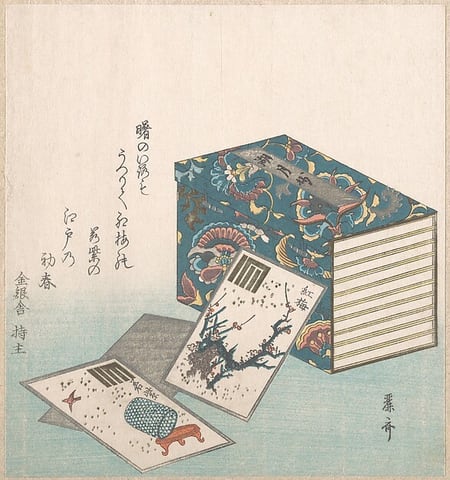
Books and Cards, by Reisai, 18th–19th century

The works in this room are listed below.

Works in this room

Prints made in the 17th century, from every museum.

Section 1, north wall

  1. The image shows a landscape with trees, rocks, and water. The perspective is slightly elevated. Rocks are prominent in the central area, with various shapes and textures. Trees and foliage are depicted with detailed brushstrokes. The color scheme is sepia, creating a warm and vintage atmosphere. The scene includes water reflecting rocks, distant hills, and faint cloud formations.
    A Rocky PondLaurent de La Hyre, 1640Courtesy National Gallery of Art, Washington
  2. The image shows a pastoral scene in black and white with fine line work. A small bridge with a circular archway crosses a stream. A dirt path winds through the landscape flanked by grass and bushes. A rocky cliff ascends on the left with a tower-like structure partially obscured by vegetation. The horizon features a cloudy sky, with swirling lines indicating motion. In the distance, a tall, thin structure, possibly a spire or chimney, stands amid faint hills and trees. The scene conveys a serene atmosphere through hatching and cross-hatching techniques.
    Cascade under a Stone BridgeJan van de Velde II, c. 1616Courtesy National Gallery of Art, Washington

Section 1, south wall

  1. The image shows a landscape with figures near a body of water. There are buildings made of logs, people gathered near a structure, and trees in the background. The style is detailed with precise linework, shading, and hatching. The color palette is monochrome, emphasizing light and shadow.
    Boat at a River Bank with Three GoatsAllart van Everdingen, probably c. 1645/1656Courtesy National Gallery of Art, Washington
  2. Books and Cards, by Reisai, 18th–19th century
    Books and CardsReisai, 18th–19th centuryCourtesy of The Metropolitan Museum of Art

Section 2, south wall
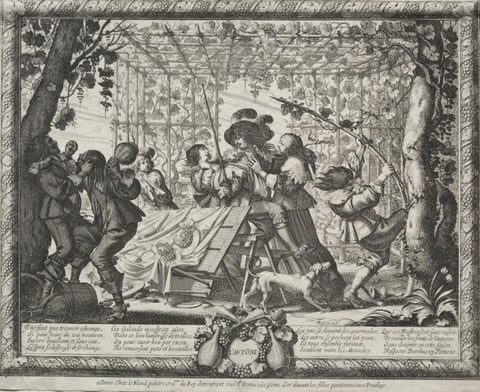
  1. The Four Seasons: Autumn, by Abraham Bosse, 1635
    The Four Seasons: AutumnAbraham Bosse, 1635Courtesy of the Cleveland Museum of Art
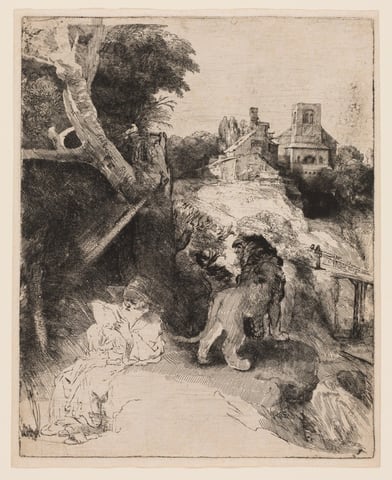
  2. A work made of etching, burin, and drypoint on ivory laid paper.
    Saint Jerome Reading in an Italian LandscapeRembrandt van Rijn, c. 1653Courtesy of the Art Institute of Chicago
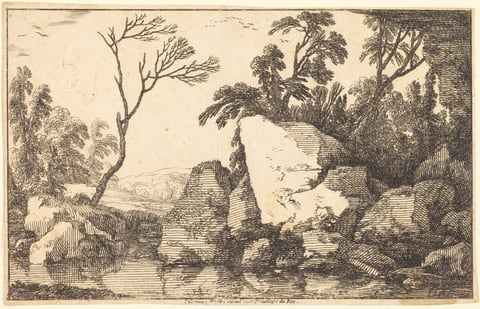
  3. The image is a landscape view with a natural scene depicted in fine etching. The horizon is situated towards the middle of the composition, where the land gently rises, and a subtle outline of distant hills is visible. Large rocks and foliage are depicted close to us, with a lone, barren tree extending upwards on the left side. The etching features intricate and well-defined brushstrokes, including thin lines and cross-hatching to create texture and depth. The color palette is monochromatic, with dark tones against a lighter background. In the distance, additional clusters of trees can be seen, rendered with similar linework to convey movement and detail.
    A Rocky PondLaurent de La Hyre, 1640Courtesy National Gallery of Art, Washington

Section 2, north wall
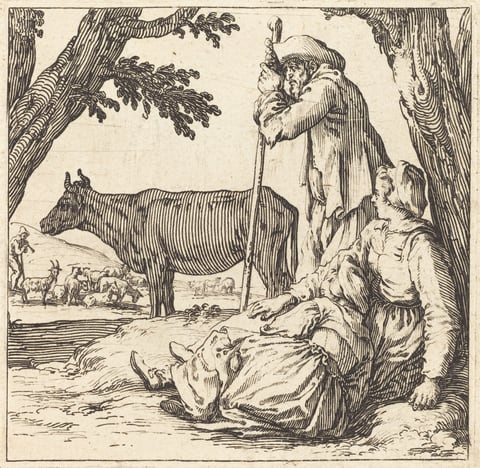
  1. The image has an elevated perspective showing two figures with animals in the scene. One person is leaning against a tree with a stick, while the other is seated on the ground. A cow is between them and other livestock in the middle distance. A person in the distance is tending to the animals. The horizon is low in the image, hidden by rolling hills. The artwork is in monochrome with fine linework, creating texture through hatching and cross-hatching, emphasizing depth and dimensionality.
    Peasant Couple with CowJacques Callot, c. 1621Courtesy National Gallery of Art, Washington
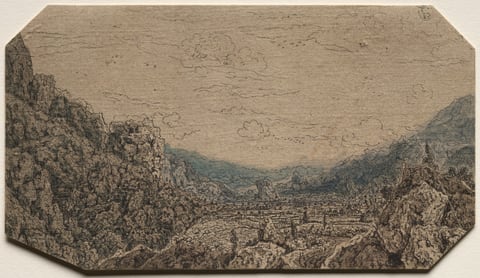
  2. Enclosed Valley, by Hercules Seghers, c. 1623–30
    Enclosed ValleyHercules Seghers, c. 1623–30Courtesy of the Cleveland Museum of Art
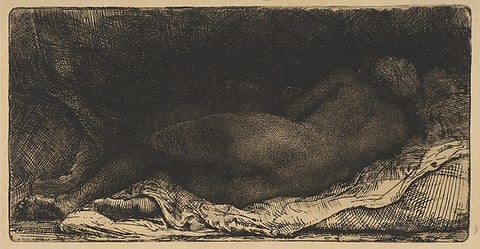
  3. Reclining Female Nude, by Rembrandt van Rijn, 1658
    Reclining Female NudeRembrandt van Rijn, 1658Courtesy of The Metropolitan Museum of Art

Section 3, north wall
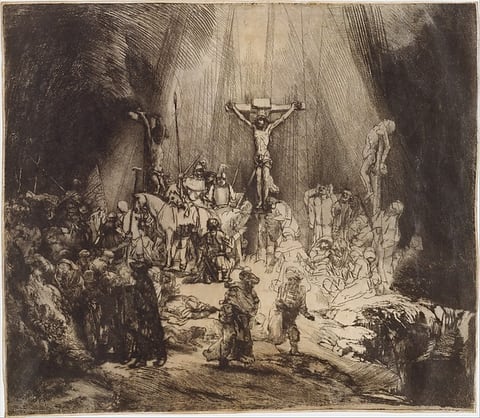
  1. Christ Crucified between the Two Thieves: The Three Crosses, by Rembrandt van Rijn, 1653
    Christ Crucified between the Two Thieves: The Three CrossesRembrandt van Rijn, 1653Courtesy of The Metropolitan Museum of Art
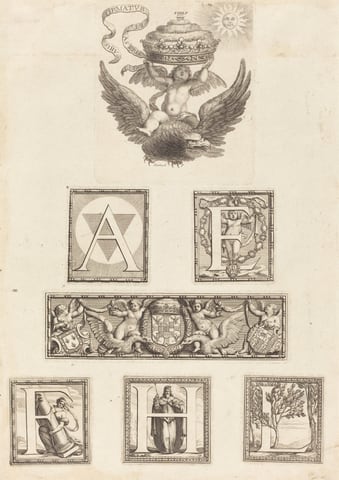
  2. This image features intricately designed ornate letters of the alphabet surrounded by elaborate illustrations. The top of the composition shows a cherub riding on an eagle, holding a crown above their head. A ribbon with inscriptions unfurls around the crown, and a sun with a human face is visible in the corner. The letters "A," "F," "D," "H," and another "H" are decorated with classical elements like putti, garlands, and mythological figures. The central panel is adorned with heraldic symbols, angelic figures, and coats of arms. The overall style of the artwork reflects baroque or renaissance decorative artistry, known for its ornamental details and classical themes.
    PendantRobert NanteuilCourtesy National Gallery of Art, Washington

Section 3, south wall
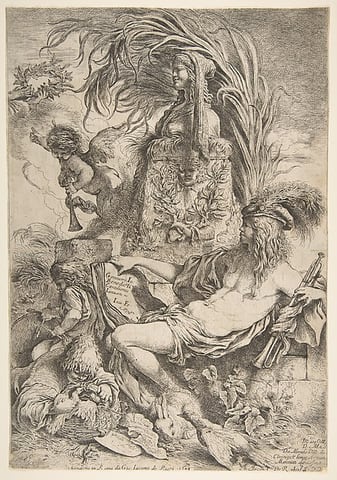
  1. The Genius of Castiglione, by Giovanni Benedetto Castiglione, ca. 1645–47 (published 1648)
    The Genius of CastiglioneGiovanni Benedetto Castiglione, ca. 1645–47 (published 1648)Courtesy of The Metropolitan Museum of Art
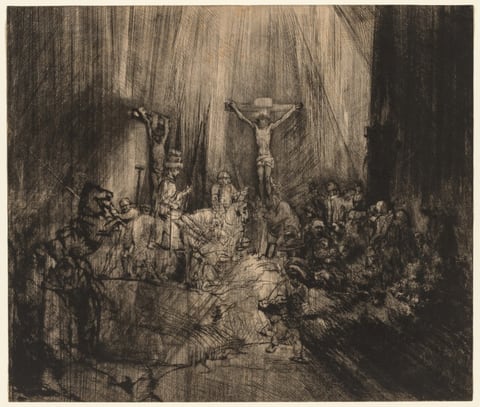
  2. Christ Crucified Between the Two Thieves: 'The Three Crosses', by Rembrandt van Rijn, 1653-c.1660
    Christ Crucified Between the Two Thieves: 'The Three Crosses'Rembrandt van Rijn, 1653-c.1660Courtesy of the Cleveland Museum of Art

Section 4, south wall
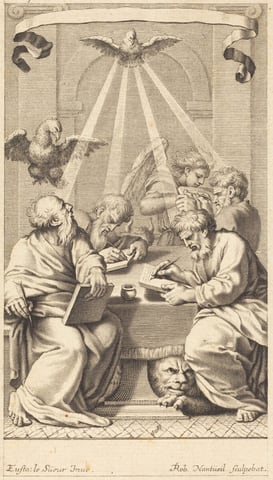
  1. The image shows four elderly men around a table. They have long hair and beards, and appear focused as they write or take notes on tablets. They wear classical robes and sit in different postures, engaged in writing or possibly calculating. Two hold writing implements and tablets, while a third holds a scroll. Above them, a seated figure with wings is present. Light rays emanate from a dove at the top, highlighting a celestial influence. An eagle is perched nearby. Architectural elements like columns and arches are in the background. A lion's head is under the table.
    The Four EvangelistsRobert NanteuilCourtesy National Gallery of Art, Washington
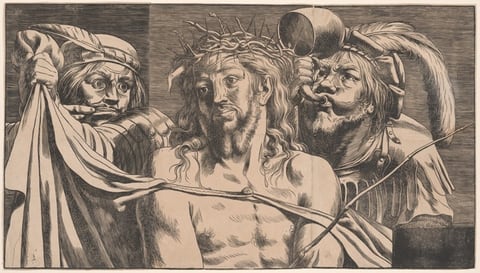
  2. A work made of woodcut on three joined sheets of ivory laid paper.
    The Mocking of ChristWerner van den Valckert, c. 1620Courtesy of the Art Institute of Chicago