Skip to content
Ochre Editions
ArtArtistsCollectionsGalleriesDrops
SearchSign inCart (0)
The galleries · Style galleries

Prints of the 17th century

Prints made in the 17th century, from every museum.

55 works · hang 8994 ·

Share Prints of the 17th century, in the galleries

The rooms are imagined; every work on their walls is real.

Walk this roomRehang this room

Section 1, north wall

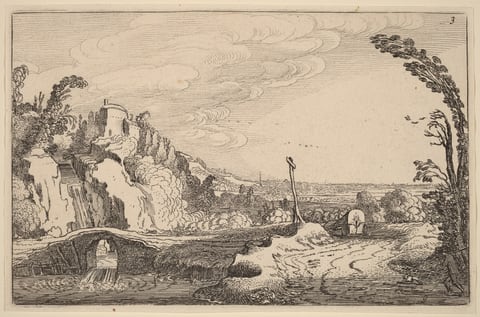
  1. The image shows a pastoral scene in black and white with fine line work. A small bridge with a circular archway crosses a stream. A dirt path winds through the landscape flanked by grass and bushes. A rocky cliff ascends on the left with a tower-like structure partially obscured by vegetation. The horizon features a cloudy sky, with swirling lines indicating motion. In the distance, a tall, thin structure, possibly a spire or chimney, stands amid faint hills and trees. The scene conveys a serene atmosphere through hatching and cross-hatching techniques.
    Cascade under a Stone BridgeJan van de Velde II, c. 1616Courtesy National Gallery of Art, Washington
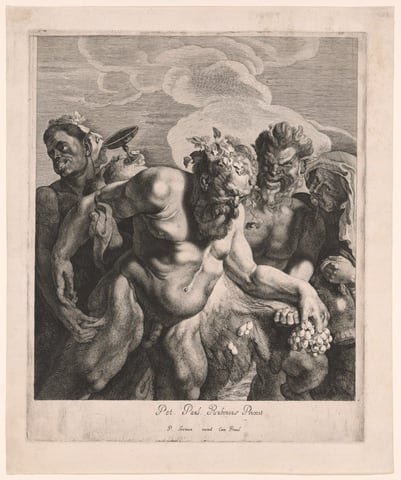
  2. A work made of engraving in black on cream laid paper.
    Drunken SilenusJonas Suyderhoef, 1642Courtesy of the Art Institute of Chicago
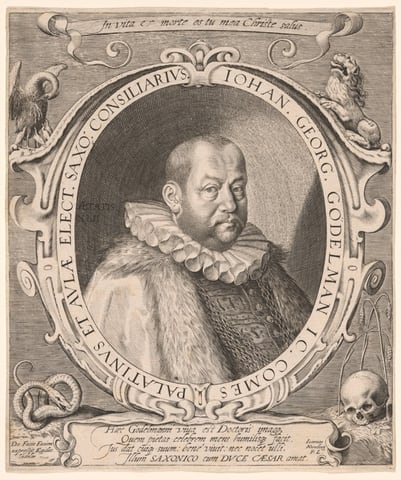
  3. A work made of engraving on paper.
    Johann Georg von Gödelmann, Law Professor, DiplomatAegidius Sadeler, II, c. 1601Courtesy of the Art Institute of Chicago

Section 1, south wall
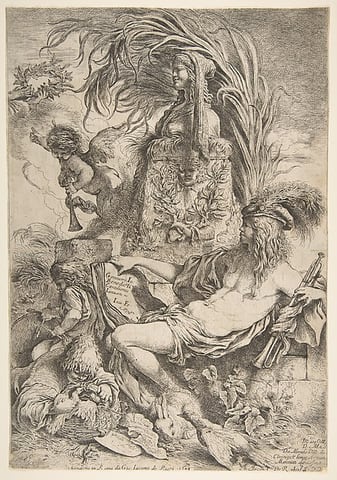
  1. The Genius of Castiglione, by Giovanni Benedetto Castiglione, ca. 1645–47 (published 1648)
    The Genius of CastiglioneGiovanni Benedetto Castiglione, ca. 1645–47 (published 1648)Courtesy of The Metropolitan Museum of Art
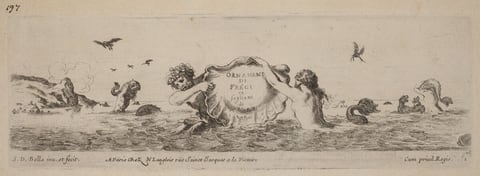
  2. This is a drawing of mythical sea creatures in a marine landscape. The central figures are depicted as mythical beings, possibly mermen, with human torsos and fish-like tails, partially submerged in water. One figure prominently holds a large seashell with text written on it. Around them are various other marine creatures and features such as a distant rocky shore, birds flying in the sky, and waves creating a dynamic setting. The drawing is detailed in line work.
    Title Page for "Ornamenti di fregi e fogliani"Stefano della Bella, probably 1648Courtesy National Gallery of Art, Washington

Section 2, south wall
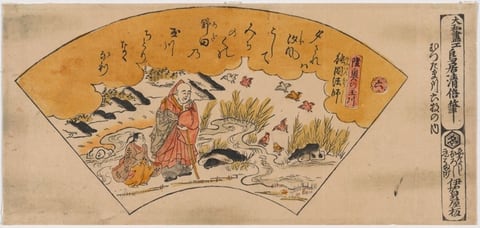
  1. A work made of woodblock print in black ink and watercolor on cream japanese paper.
    The Priest Kobo Daishi at the Tama River in Kii Province from the series The Six Tama RiversTorii Kiyomasu, c. 1725-1735Courtesy of the Art Institute of Chicago
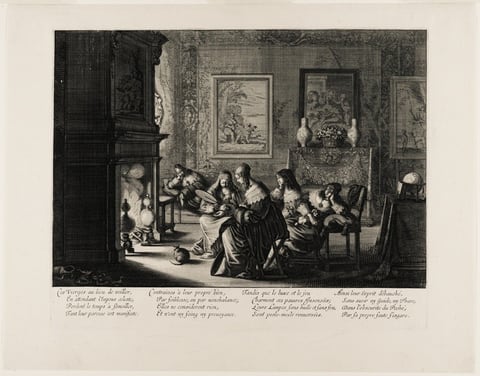
  2. A work made of engraving and etching on ivory laid paper.
    The Wise and Foolish Virgins, plate fiveAbraham Bosse, 1635Courtesy of the Art Institute of Chicago
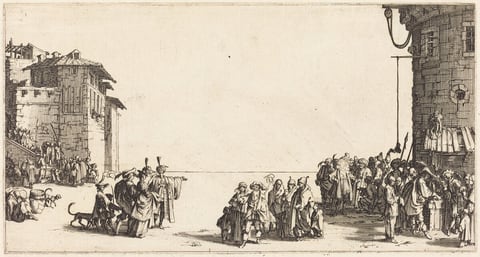
  3. This is a drawing of a busy street scene with architectural structures and various figures. It depicts a large open area bordered by a grand building to the left and a rounded tower or structure to the right. The left side of the scene is lined with stairs leading up to an elevated walkway or platform, where people are gathered. In the middle and to the right, a crowd has formed, encompassing the space in front of the tower. Various individuals, some wearing distinctive headgear, are seen mingling and gesturing. The architectural details in the background, such as the windows and brickwork of the tower, frame the scene below. A hand-operated apparatus extends from the tower, possibly for lifting goods or supplies. The drawing captures a dynamic urban moment.
    The Slave MarketJacques Callot, 1620Courtesy National Gallery of Art, Washington

Section 2, north wall
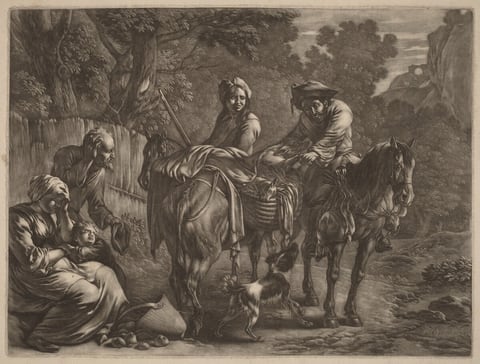
  1. This is a drawing of a rural scene with horses and figures. The image shows an interaction between several figures and two horses within a pastoral setting. In the foreground, two individuals are seated on the ground, accompanied by a small child. Nearby, a figure atop a horse reaches towards another figure who leads a laden horse. A dog is present, standing alert at the horse's hooves. The backdrop showcases lush trees and distant hills, suggesting a serene countryside environment. The attention to detail and shading creates a realistic depiction of this rustic scene.
    Robbers on HorsebackJan van Huchtenburgh, late 17th/early 18th centuryCourtesy National Gallery of Art, Washington
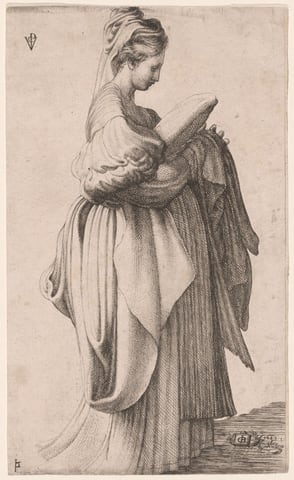
  2. A work made of etching in black ink on cream laid paper.
    A Young Woman Holding a CushionMonogrammist VCP, 1643Courtesy of the Art Institute of Chicago

Section 3, north wall
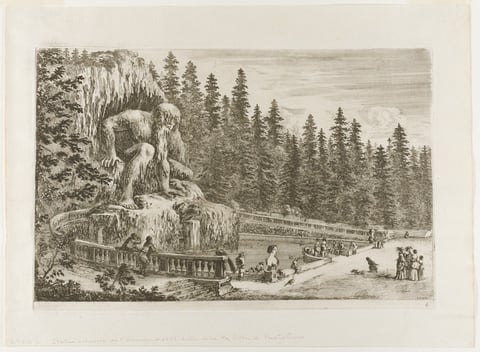
  1. A work made of etching in black on ivory laid paper.
    The Colossal Statue of the Apennines, from Views of Villa di PratolinoStefano della Bella, c. 1653Courtesy of the Art Institute of Chicago
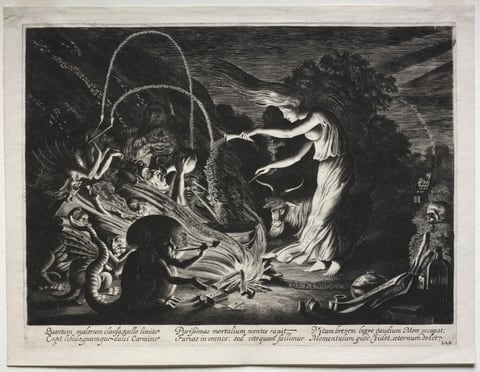
  2. The Witch (Night Piece), by Jan van de Velde II, 1626
    The Witch (Night Piece)Jan van de Velde II, 1626Courtesy of the Cleveland Museum of Art

Section 3, south wall
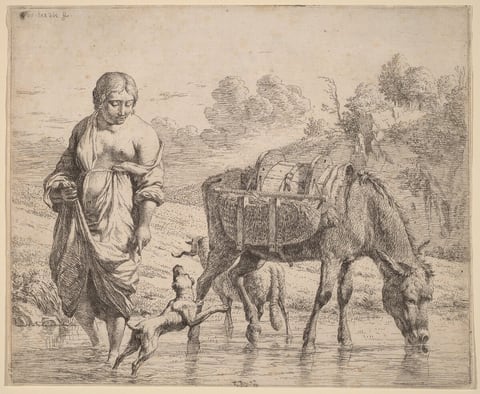
  1. The image shows a woman standing close to us, slightly turned to the side, looking down, with a hand supporting her draped attire and the other grasping a stick. Next to her, a donkey drinks from a shallow stream, carrying a large wicker basket with barrels inside. A dog is splashing in the water beside them. The horizon is low, meeting a rise of land with trees and shrubs, leading the eye to a distant pathway where a couple of small figures can be seen. The sky above has sketchily rendered clouds. The style involves fine, detailed linework, characteristic of etching, emphasizing textures such as the fur of the donkey and the folds of the fabric. The color palette is monochromatic, relying on various intensities of ink and line density to render shadows and highlights.
    Woman Crossing a StreamKarel Dujardin, 1662Courtesy National Gallery of Art, Washington
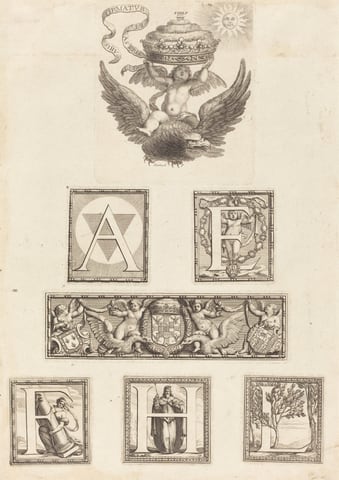
  2. This image features intricately designed ornate letters of the alphabet surrounded by elaborate illustrations. The top of the composition shows a cherub riding on an eagle, holding a crown above their head. A ribbon with inscriptions unfurls around the crown, and a sun with a human face is visible in the corner. The letters "A," "F," "D," "H," and another "H" are decorated with classical elements like putti, garlands, and mythological figures. The central panel is adorned with heraldic symbols, angelic figures, and coats of arms. The overall style of the artwork reflects baroque or renaissance decorative artistry, known for its ornamental details and classical themes.
    PendantRobert NanteuilCourtesy National Gallery of Art, Washington

Section 4, south wall
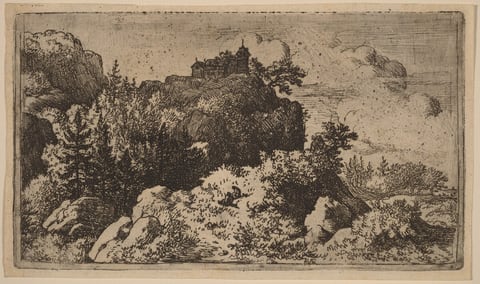
  1. The image shows a slightly elevated perspective of a rugged landscape with dense vegetation and rock formations. The horizon is high in the upper third of the image, with a distant building or castle on a hill. The structure is silhouetted against the sky and partially obscured by foliage. Intricate line work and hatching create detailed textures and shading, especially in the trees and clouds. The color palette is monochromatic, using varying shades of brown and sepia to give the artwork an antiquated and rustic appearance.
    Firs in the DefileAllart van Everdingen, probably c. 1645/1656Courtesy National Gallery of Art, Washington
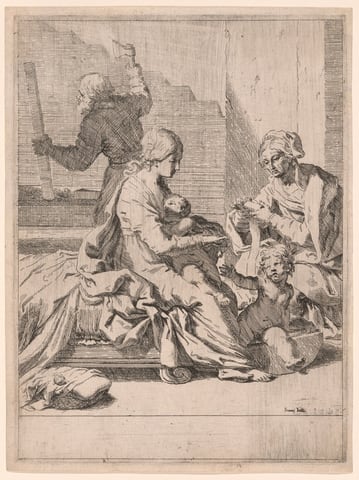
  2. A work made of etching in black on cream laid paper.
    Holy Family with Saint Elizabeth and Saint John the BaptistElisabetta Sirani, 1650/60Courtesy of the Art Institute of Chicago

Walk on

  • Prints of the 17th century, room 2
  • Elisabetta Sirani's contemporaries 8 works
  • 17th-century Italy 39 works
Ochre Editions

The world's museums, on your wall. Every work here is a reproduction of a public-domain original, credited to the museum that holds it.

Shop

All artCollectionsLimited dropsPrints and framing

Help

Find an orderShippingReturnsVerify a certificate

About

About Ochre EditionsMuseum creditsFor agentsDevelopers

Legal

Terms of UseTerms of SaleLimited Editions and CertificatesPrivacy PolicyCookie PolicyAcceptable Use PolicyAgent & API TermsCopyright and DMCA PolicyPrinting Your Own PhotoVulnerability Disclosure PolicyAccessibility StatementOpen-Access Credits
© 2026 Ochre EditionsPrices in US dollars. Prints ship within the United States.