Floor plan

Style galleriesPrints of the 18th century
Prints of the 18th century
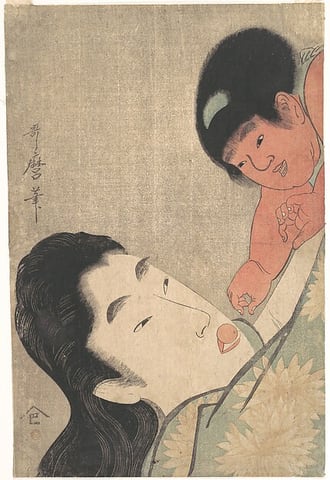
Yamauba and Kintarō Playing with a Cherry, by Kitagawa Utamaro, ca. 1795
A work made of chiaroscuro woodcut, from three blocks in pink, dark blue, and light blue, on cream laid paper.
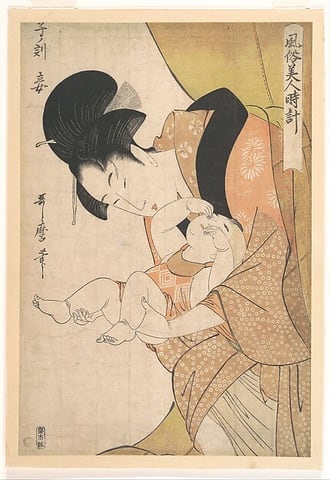
“Hour of the Rat: Mistress,” from the series Women’s Daily Customs (Fuzoku bijin tokei), by Kitagawa Utamaro, 1790
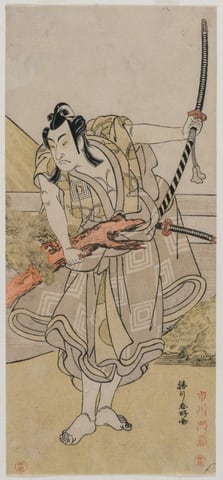
Ichikawa Monnosuke II as Soga no Gorō, by Katsukawa Shunkō, 1779
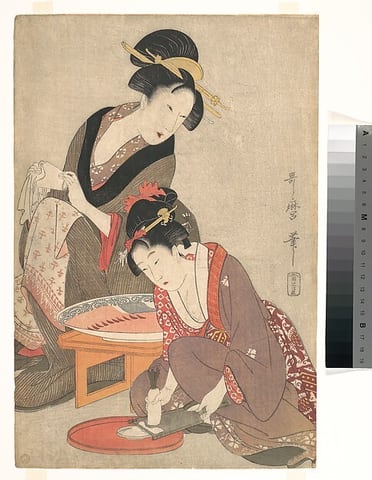
Women Grating Radish for Sashimi, by Kitagawa Utamaro, ca. 1798–99
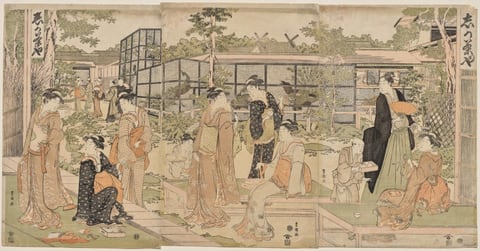
The Shika Teahouse, by Utagawa Toyokuni, early 1790s

The works in this room are listed below.

Works in this room

Prints made in the 18th century, from every museum.

Section 1, north wall

  1. Yamauba and Kintarō Playing with a Cherry, by Kitagawa Utamaro, ca. 1795
    Yamauba and Kintarō Playing with a CherryKitagawa Utamaro, ca. 1795Courtesy of The Metropolitan Museum of Art
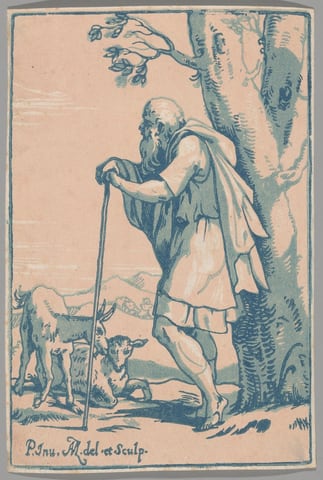
  2. A work made of chiaroscuro woodcut, from three blocks in pink, dark blue, and light blue, on cream laid paper.
    The Old ShepherdConte Antonio Maria Zanetti, the Elder, 1722Courtesy of the Art Institute of Chicago
  3. “Hour of the Rat: Mistress,” from the series Women’s Daily Customs (Fuzoku bijin tokei), by Kitagawa Utamaro, 1790
    “Hour of the Rat: Mistress,” from the series Women’s Daily Customs (Fuzoku bijin tokei)Kitagawa Utamaro, 1790Courtesy of The Metropolitan Museum of Art

Section 1, south wall

  1. Ichikawa Monnosuke II as Soga no Gorō, by Katsukawa Shunkō, 1779
    Ichikawa Monnosuke II as Soga no GorōKatsukawa Shunkō, 1779Courtesy of the Cleveland Museum of Art
  2. Women Grating Radish for Sashimi, by Kitagawa Utamaro, ca. 1798–99
    Women Grating Radish for SashimiKitagawa Utamaro, ca. 1798–99Courtesy of The Metropolitan Museum of Art
  3. The Shika Teahouse, by Utagawa Toyokuni, early 1790s
    The Shika TeahouseUtagawa Toyokuni, early 1790sCourtesy of the Cleveland Museum of Art

Section 2, south wall
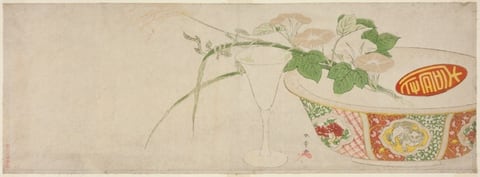
  1. A work made of color woodblock print; long surimono.
    Plants, Porcelain Bowl, and Glass GobletKatsukawa Shunshō, c. 1789Courtesy of the Art Institute of Chicago
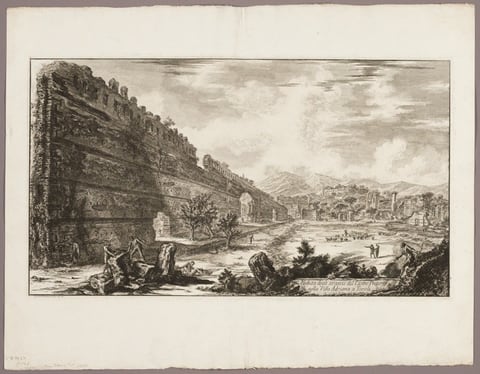
  2. A work made of etching on heavy ivory laid paper.
    View of the Remains of the Praetorian Fort [the Poecile], Hadrian's Villa, Tivoli, from Views of RomeGiovanni Battista Piranesi, 1770Courtesy of the Art Institute of Chicago

Section 2, north wall
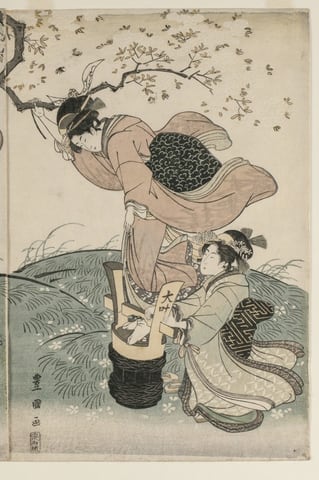
  1. Cherry Blossoms in the Wind, by Utagawa Toyokuni, late 1790s
    Cherry Blossoms in the WindUtagawa Toyokuni, late 1790sCourtesy of the Cleveland Museum of Art
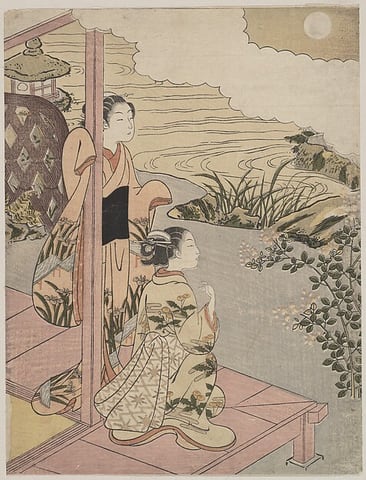
  2. Two Girls on a Veranda beside a Stream with the Moon, by Suzuki Harunobu
    Two Girls on a Veranda beside a Stream with the MoonSuzuki HarunobuCourtesy of The Metropolitan Museum of Art
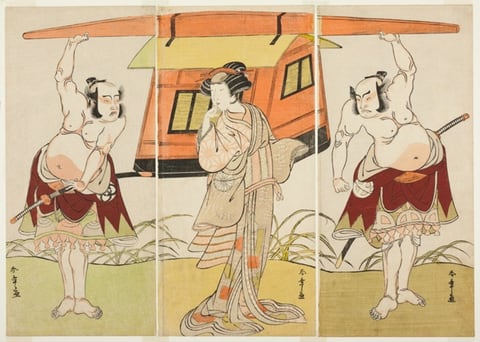
  3. A work made of color woodblock print; hosoban; triptych.
    The Actors Otani Hiroji III as Yokambei (right), Nakamura Tomijuro I as Kuzunoha (center), and Bando Mitsugoro I as Yakambei (left), in the Last Scene from the Play Shinodazuma (The Wife from Shinoda Forest), Performed as a Supplement to the Play Kikyo-zome Onna Urakata (Female Diviner in Deep Violet), at the Morita Theater from the Ninth Day of the Ninth Month, 1776Katsukawa Shunshō, c. 1776Courtesy of the Art Institute of Chicago

Section 3, north wall
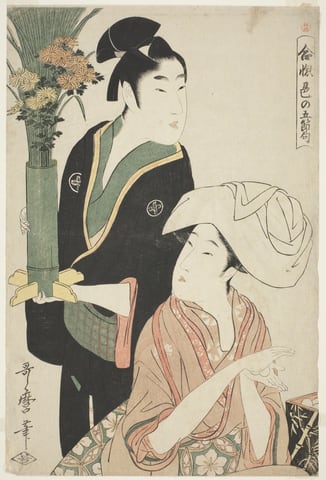
  1. A work made of color woodblock print; oban.
    The Ninth Month, from the series Five Amorous Festivals of Love (Aibore iro no gosekku)Kitagawa Utamaro, 1801Courtesy of the Art Institute of Chicago
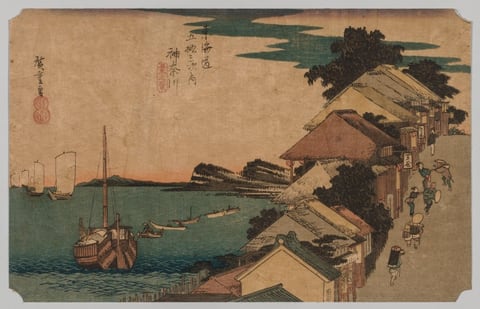
  2. Kanagawa, Inland Sea: Top of the Street, by Utagawa Hiroshige, 1797–1858
    Kanagawa, Inland Sea: Top of the StreetUtagawa Hiroshige, 1797–1858Courtesy of the Cleveland Museum of Art
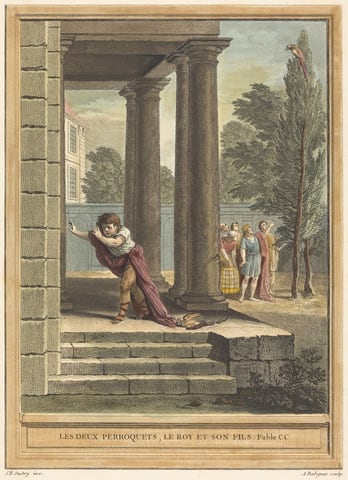
  3. This painting depicts a classical architectural scene with a bird and multiple individuals. It is done in the style of Jean-Baptiste Oudry. The image includes a large building with stone columns and stairs. A parrot is perched on a tree, catching attention with its colorful feathers. In the foreground, a person in classical clothing appears to be in motion. In the background, a group of people are gathered with varied expressions and gestures directed towards the person in the foreground. The architectural elements and foliage add depth and context to the scene.
    Les deux perroquets, le roi et son fils (Two Parrots, the King, and His Son)Antoine Radigues, published 1759Courtesy National Gallery of Art, Washington

Section 3, south wall
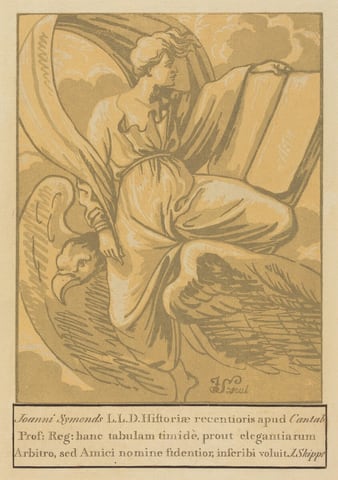
  1. This is a drawing of a winged figure seated on a bird. The image depicts a figure with flowing robes, wings outstretched, holding an open book in one hand. The figure appears to be looking off to the side, with a serene expression. The lower part of the image includes a bird upon which the figure is seated. The bird's head is turned slightly upwards, following the direction in which the figure is gazing. The image is rendered in a warm, monochromatic palette. In the lower section of the image, there is some text, likely Latin.
    Saint John the EvangelistJohn Skippe, 1771Courtesy National Gallery of Art, Washington
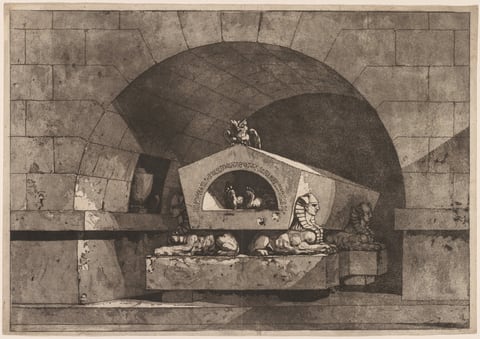
  2. Tomb with Sphinxes and an Owl, by Louis Jean Desprez, c. 1779–84
    Tomb with Sphinxes and an OwlLouis Jean Desprez, c. 1779–84Courtesy of the Cleveland Museum of Art