Floor plan

North wing: East AsiaThe Floating World

The Floating World

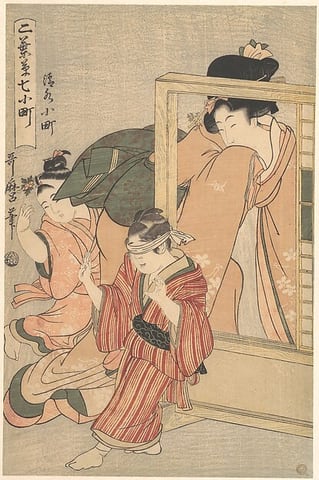
Kiyomizu Komachi, from the series Futabagusa nana Komachi, by Kitagawa Utamaro, 1790s
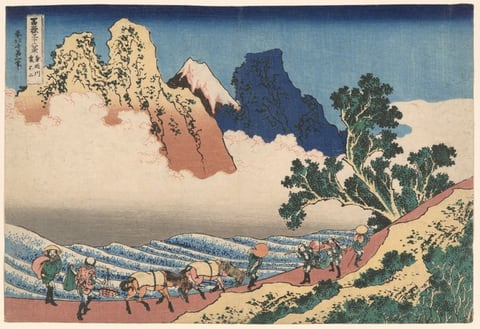
Print showing a string of travelers with horses walking along a narrow hillside path beneath an enormous craggy beige mountain at left and an equally massive and craggy deep-blue mountain at right. A brown snow-covered peak appears between these mountains. A mass of cream-colored clouds and a river with rounded ripples fill the middle plane of the composition.
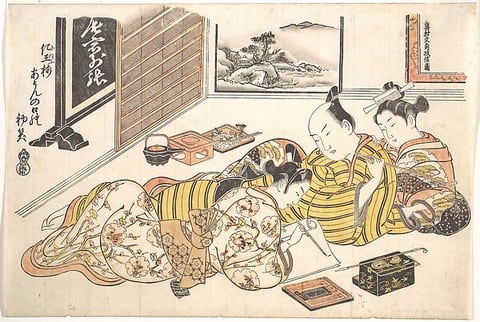
Plate from the Erotic Book Mounds of Dyed Colors: A Pattern Book for the Boudoir (Someiro no yama neya no hinagata), First Month, by Okumura Masanobu, ca. 1736–44
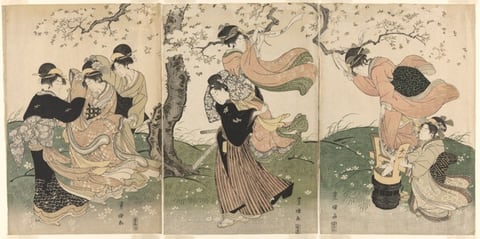
A work made of color woodblock prints; oban triptych.
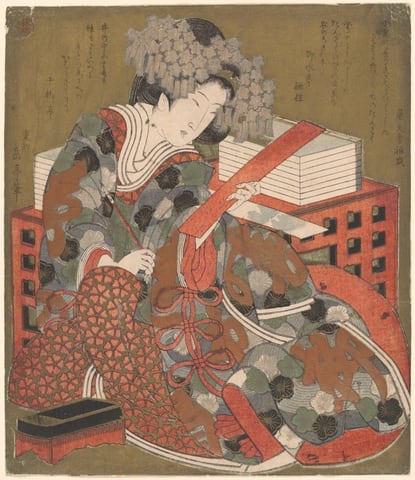
A work made of color woodblock print with metallic pigments; surimono shikishiban.

The works in this room are listed below.

Works in this room

Japanese woodblock prints of the floating world: actors, courtesans, landscapes and the sea.

Section 1, north wall

  1. Kiyomizu Komachi, from the series Futabagusa nana Komachi, by Kitagawa Utamaro, 1790s
    Kiyomizu Komachi, from the series Futabagusa nana KomachiKitagawa Utamaro, 1790sCourtesy of The Metropolitan Museum of Art
  2. Print showing a string of travelers with horses walking along a narrow hillside path beneath an enormous craggy beige mountain at left and an equally massive and craggy deep-blue mountain at right. A brown snow-covered peak appears between these mountains. A mass of cream-colored clouds and a river with rounded ripples fill the middle plane of the composition.
    The Back of Mount Fuji Seen from Minobu River (Minobugawa Urafuji), from the series Thirty-Six Views of Mount Fuji (Fugaku sanjūrokkei)Katsushika Hokusai, 1830-33Courtesy of the Art Institute of Chicago
  3. Plate from the Erotic Book Mounds of Dyed Colors: A Pattern Book for the Boudoir (Someiro no yama neya no hinagata), First Month, by Okumura Masanobu, ca. 1736–44
    Plate from the Erotic Book Mounds of Dyed Colors: A Pattern Book for the Boudoir (Someiro no yama neya no hinagata), First MonthOkumura Masanobu, ca. 1736–44Courtesy of The Metropolitan Museum of Art

Section 1, south wall

  1. A work made of color woodblock prints; oban triptych.
    A Windy Day under the Cherry TreesUtagawa Toyokuni, c. 1797Courtesy of the Art Institute of Chicago
  2. A work made of color woodblock print with metallic pigments; surimono shikishiban.
    Woman About to Write a PoemYashima Gakutei, c. 1824Courtesy of the Art Institute of Chicago

Section 2, south wall
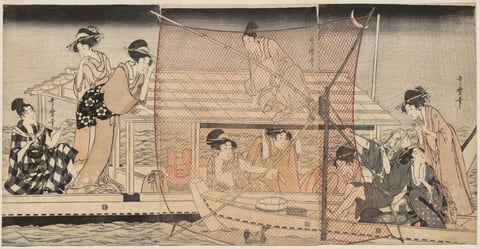
  1. Net Fishing at Night on the Sumida River, by Kitagawa Utamaro, c. 1800
    Net Fishing at Night on the Sumida RiverKitagawa Utamaro, c. 1800Courtesy of the Cleveland Museum of Art
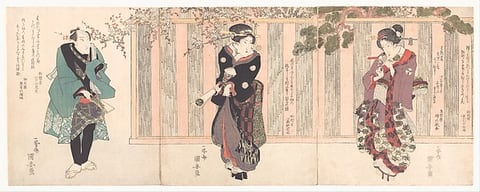
  2. Three Kabuki Actors Playing Hanetsuki, by Utagawa Kuniyasu, ca. 1823
    Three Kabuki Actors Playing HanetsukiUtagawa Kuniyasu, ca. 1823Courtesy of The Metropolitan Museum of Art

Section 2, north wall
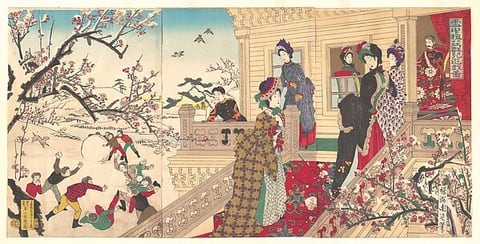
  1. Children Playing in the Snow under Plum Trees in Bloom (Secchū baisō gunji yūgi zu), by Yōshū (Hashimoto) Chikanobu, November 1887
    Children Playing in the Snow under Plum Trees in Bloom (Secchū baisō gunji yūgi zu)Yōshū (Hashimoto) Chikanobu, November 1887Courtesy of The Metropolitan Museum of Art
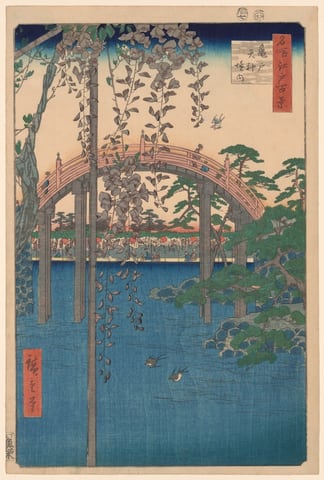
  2. A work made of color woodblock print; oban.
    Precincts of Kameido Tenjin Shrine (Kameido Tenjin keidai), from the series "One Hundred Famous Views of Edo (Meisho Edo hyakkei)"Utagawa Hiroshige, 1856Courtesy of the Art Institute of Chicago

Section 3, north wall
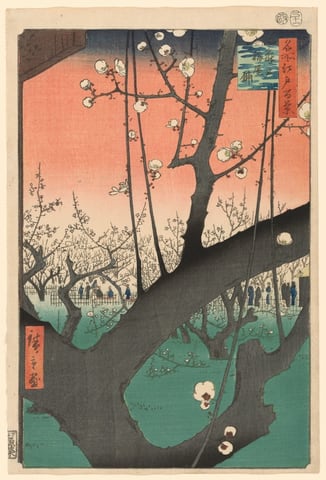
  1. A work made of color woodblock print; ōban.
    Plum Garden at Kameido (Kameido Umeyashiki), from the series "One Hundred Famous Views of Edo (Meisho Edo hyakkei)"Utagawa Hiroshige, 1857Courtesy of the Art Institute of Chicago
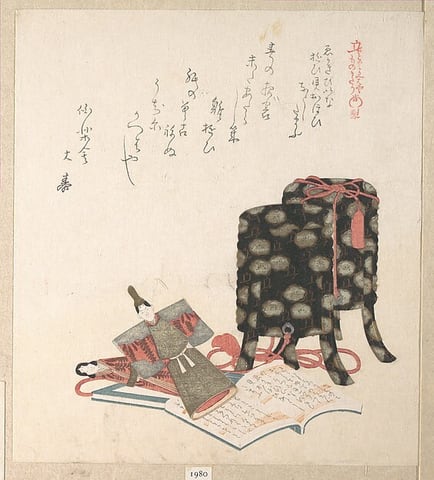
  2. The Doll Festival, Third Day of the Third Month, by Kubo Shunman, 19th century
    The Doll Festival, Third Day of the Third MonthKubo Shunman, 19th centuryCourtesy of The Metropolitan Museum of Art

Section 3, south wall
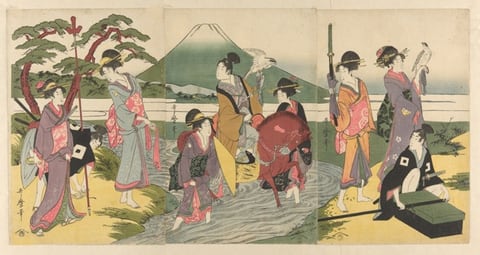
  1. A work made of color woodblock print; oban triptych.
    Young man and his party crossing a stream before Mt. FujiKitagawa Utamaro, c. 1798/1800Courtesy of the Art Institute of Chicago
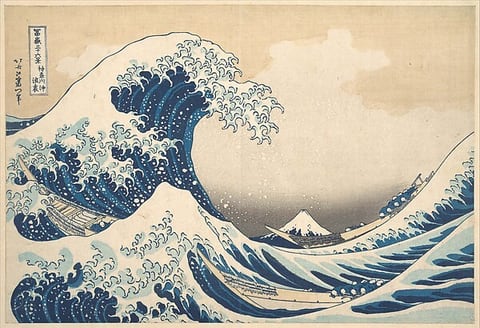
  2. Under the Wave off Kanagawa (Kanagawa oki nami ura), or The Great Wave, from the series Thirty-six Views of Mount Fuji (Fugaku sanjūrokkei), by Katsushika Hokusai, ca. 1830–32
    Under the Wave off Kanagawa (Kanagawa oki nami ura), or The Great Wave, from the series Thirty-six Views of Mount Fuji (Fugaku sanjūrokkei)Katsushika Hokusai, ca. 1830–32Courtesy of The Metropolitan Museum of Art

Section 4, south wall
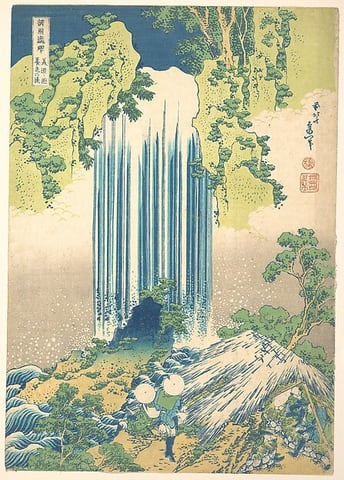
  1. Yōrō Waterfall in Mino Province (Mino no Yōrō no taki), from the series A Tour of Waterfalls in Various Provinces (Shokoku taki meguri), by Katsushika Hokusai, ca. 1832
    Yōrō Waterfall in Mino Province (Mino no Yōrō no taki), from the series A Tour of Waterfalls in Various Provinces (Shokoku taki meguri)Katsushika Hokusai, ca. 1832Courtesy of The Metropolitan Museum of Art
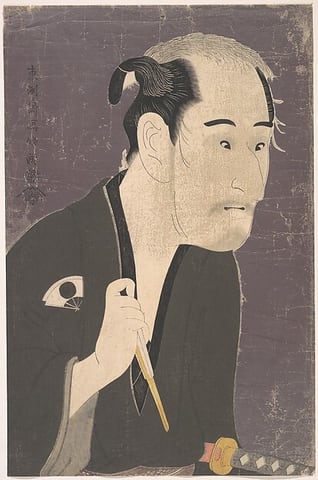
  2. The Actor Onoye Matsusuke as a Ronin, by Tōshūsai Sharaku
    The Actor Onoye Matsusuke as a RoninTōshūsai SharakuCourtesy of The Metropolitan Museum of Art
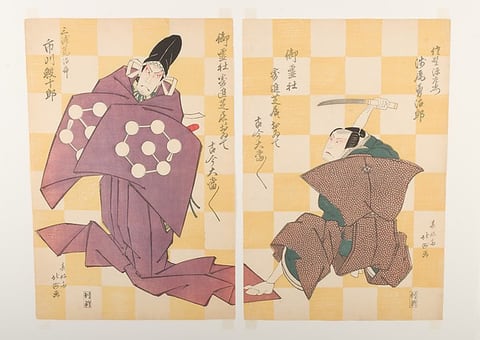
  3. Kabuki Actors Asao Yūjirō as Sano Genzaemon and Ichikawa Ebijūrō I as Miura Arajirō, in the play Keisei Sano no Funabashi, by Shunkōsai Hokushū, 1822
    Kabuki Actors Asao Yūjirō as Sano Genzaemon and Ichikawa Ebijūrō I as Miura Arajirō, in the play Keisei Sano no FunabashiShunkōsai Hokushū, 1822Courtesy of The Metropolitan Museum of Art