Floor plan

The RotundaThe Rotunda

The Rotunda

Painting
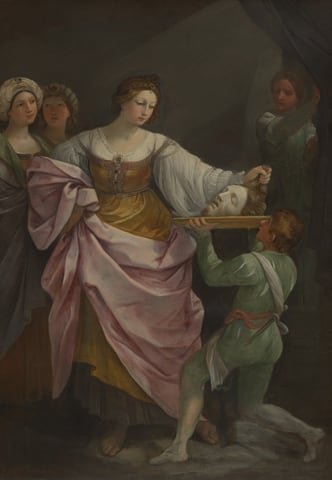
Large painting of woman, in gold and pink dress, placing severed head on platter.
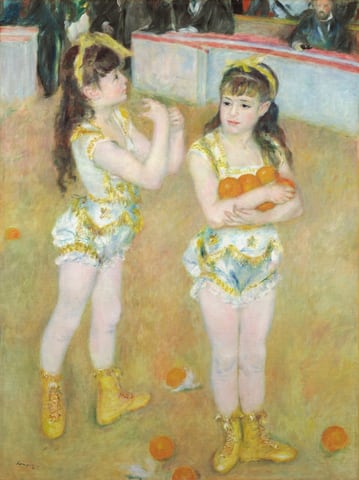
Two girls in acrobatic uniforms stand in an arena, one holds oranges.
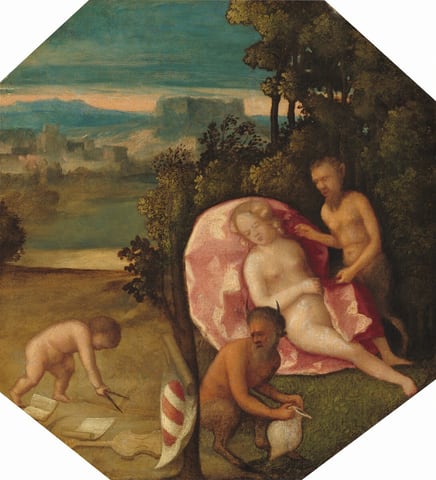
A nude woman, pudgy child, and two satyrs, which have men’s heads and torsos with goat’s legs and horns, are in a landscape in this octagonal painting. The scene is divided in half by a tree stump which only reaches to the center of the composition. To the left of the stump, the pale-skinned, nude child stands and hunches over to draw on the ground with a V-shaped compass. Two pieces of paper and a violin lie nearby. The landscape behind him has a body of water leading back to a town with buildings streaked with peach, perhaps flames. A band of peach sky separates the blue silhouettes of mountains lining the horizon from the vivid blue sky above. At the bottom center of the painting, a shield with an oval horizontally striped with red and white leans on the boy’s side of the tree, which has one leafy branch growing on the left side. One satyr holds a jug and kneels close to the tree with his back to it as he looks back over one shoulder. He and the other satyr both have dark, peach-toned skin and full beards. The second satyr hovers to the right of the nude, sleeping woman, both hands reaching for her or the rose-pink cloth surrounding her. The woman has blond curls, a round face, and she sleeps with one hand resting across her belly and her head tipped to our left. The trio are on a grassy area enclosed by dense, dark-green bushes and trees.

The works in this room are listed below.

Works in this room

The entrance hall. Its bays hold the works that show each museum at its fullest: large paintings first, a few from each collection, rehung every day.

Bay 1

  1. Painting
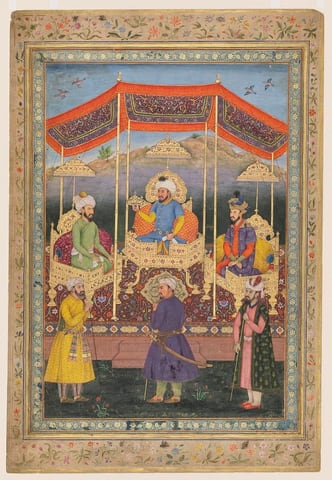
    Ancestral group of Mughal rulersGovardhan, 18th centuryCourtesy of the National Museum of Asian Art, Smithsonian Institution
  2. Large painting of woman, in gold and pink dress, placing severed head on platter.
    Salome with the Head of Saint John the BaptistGuido Reni, c. 1639–42Courtesy of the Art Institute of Chicago

Bay 2

  1. Two girls in acrobatic uniforms stand in an arena, one holds oranges.
    Acrobats at the Cirque Fernando (Francisca and Angelina Wartenberg)Pierre-Auguste Renoir, 1879Courtesy of the Art Institute of Chicago
  2. A nude woman, pudgy child, and two satyrs, which have men’s heads and torsos with goat’s legs and horns, are in a landscape in this octagonal painting. The scene is divided in half by a tree stump which only reaches to the center of the composition. To the left of the stump, the pale-skinned, nude child stands and hunches over to draw on the ground with a V-shaped compass. Two pieces of paper and a violin lie nearby. The landscape behind him has a body of water leading back to a town with buildings streaked with peach, perhaps flames. A band of peach sky separates the blue silhouettes of mountains lining the horizon from the vivid blue sky above. At the bottom center of the painting, a shield with an oval horizontally striped with red and white leans on the boy’s side of the tree, which has one leafy branch growing on the left side. One satyr holds a jug and kneels close to the tree with his back to it as he looks back over one shoulder. He and the other satyr both have dark, peach-toned skin and full beards. The second satyr hovers to the right of the nude, sleeping woman, both hands reaching for her or the rose-pink cloth surrounding her. The woman has blond curls, a round face, and she sleeps with one hand resting across her belly and her head tipped to our left. The trio are on a grassy area enclosed by dense, dark-green bushes and trees.
    AllegoryPietro degli Ingannati, c. 1515-1525Courtesy National Gallery of Art, Washington

Bay 3
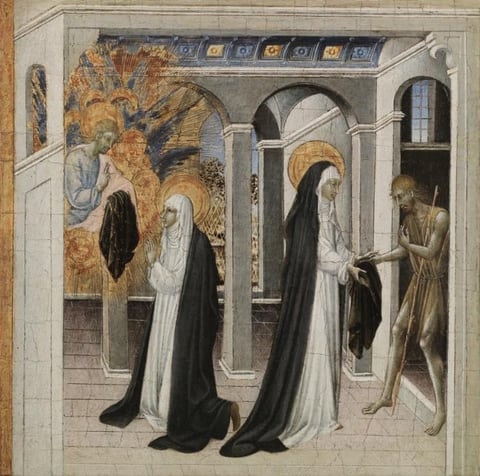
  1. St. Catherine of Siena and the Beggar, by Giovanni di Paolo, 1460s
    St. Catherine of Siena and the BeggarGiovanni di Paolo, 1460sCourtesy of the Cleveland Museum of Art
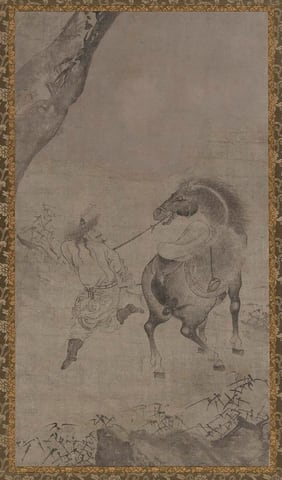
  2. Hanging scroll (mounted on panel)
    A horse and riderLi Gonglin, 16th century?Courtesy of the National Museum of Asian Art, Smithsonian Institution

Bay 4
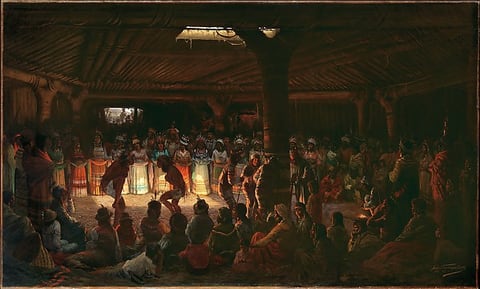
  1. Dance in a Subterranean Roundhouse at Clear Lake, California, by Jules Tavernier, 1878
    Dance in a Subterranean Roundhouse at Clear Lake, CaliforniaJules Tavernier, 1878Courtesy of The Metropolitan Museum of Art
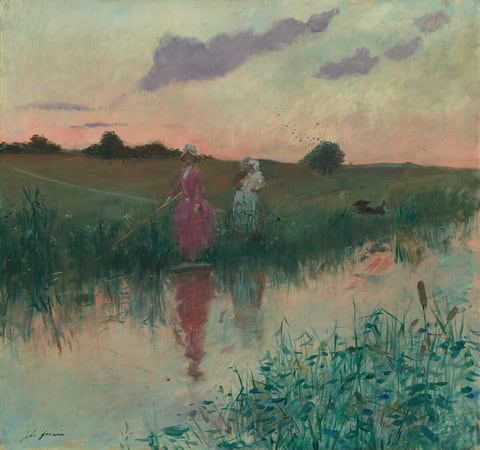
  2. In this painting, there are two women standing near a body of water, surrounded by tall green grass and white flowers. One woman wears a bright pink dress, while the other wears a brown dress with a white apron. The woman in pink holds a long, thin rod outwards, its other end connected to a thin string and a small red lure floating on the water. The other woman stands behind her and holds a baby wearing white clothes and a white bonnet. Behind both women, on the right, is a brown shape like a small dog running towards them. The reflection of the women is visible against the still, blue water. The sky is light blue at the top, transitioning to a warm pink by the horizon, crossed by purple clouds and a flock of small birds. In the bottom right corner, across the water from the women, is a patch of more tall blue-and-green grass. The brushstrokes of the painting are light and feathery.
    The Artist's Wife FishingJean Louis Forain, 1896Courtesy National Gallery of Art, Washington