Floor plan

East wing: The Nineteenth CenturyImpressionism

Impressionism

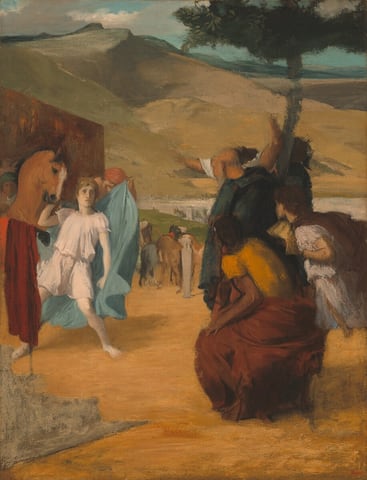
Two groups of people face off in front of a hilly landscape in this loosely painted, vertical scene. On our left, a pale young man in a white tunic looks with eyes wide and lips parted at a group of three people on our right. The young man's right hand, on our left, is raised to stroke the head of a reddish-brown horse at his right shoulder. He stands with feet planted wide, knees bent, and he curls his left hand into a fist. Behind him, a man holds up a fluttering, light blue cape. A mottled red wall forms a backdrop to this scene on our left. The tight group gathered under a tree on our right stares back at the young man. The trio is made up of a balding, older man, a light-skinned boy also wearing a white tunic, and, closest to us, a brown-skinned woman wearing a marigold-orange shirt and a maroon-red skirt. Behind this group, a pair of pale raised arms suggests a fourth person, but the head is missing or has been painted over. The ground under the people is saffron orange. In the center of the picture, beyond the people, a group of horses stands near a green bank by a river, its surface reflecting white. The far bank is lined with white buildings. Tan and olive-green slopes rise from the opposite riverbank under a pale blue sky with cream-white clouds sweeping along the top edge of the composition. The artist signed his name in red paint in the lower right corner: “Degas.”
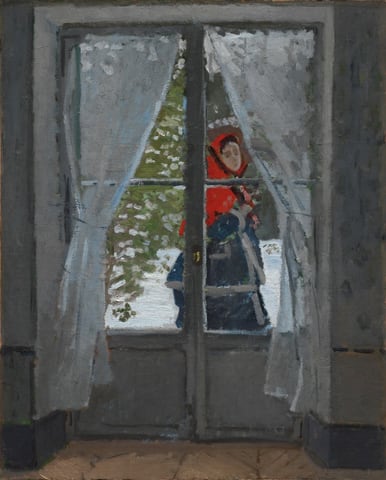
The Red Kerchief, by Claude Monet, c. 1868–73
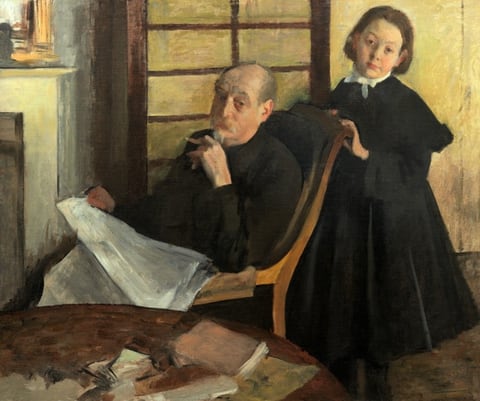
Impressionist painting of seated man, girl with brown, black hues.
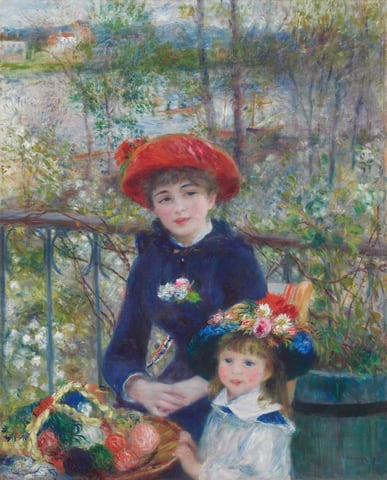
Impressionist painting of two girls on balcony, bright flower hat, knitting basket.
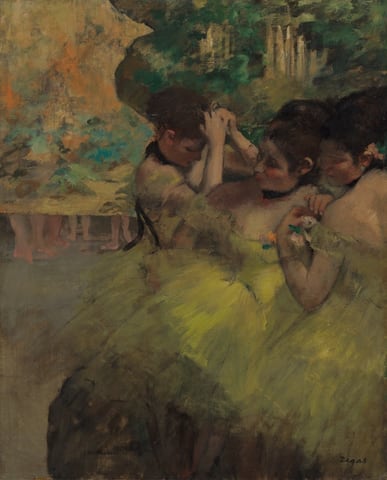
Three light-skinned, dark-haired ballerinas, painted in muted tones, wear off-the-shoulder yellow leotards and tutus as they huddle near each other. One adjusts her costume, while one holds her hands clasped above her head. At left is a painted screen with four pairs of feet visible underneath.
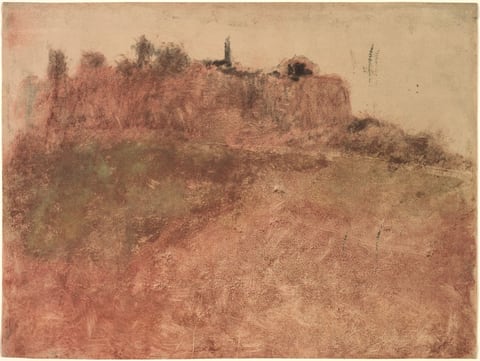
Estérel Village, by Edgar Degas, c. 1890

The works in this room are listed below.

Works in this room

Painters in 1870s Paris who worked quickly, often outdoors, to catch light as it changed.

First room, north wall

  1. Two groups of people face off in front of a hilly landscape in this loosely painted, vertical scene. On our left, a pale young man in a white tunic looks with eyes wide and lips parted at a group of three people on our right. The young man's right hand, on our left, is raised to stroke the head of a reddish-brown horse at his right shoulder. He stands with feet planted wide, knees bent, and he curls his left hand into a fist. Behind him, a man holds up a fluttering, light blue cape. A mottled red wall forms a backdrop to this scene on our left. The tight group gathered under a tree on our right stares back at the young man. The trio is made up of a balding, older man, a light-skinned boy also wearing a white tunic, and, closest to us, a brown-skinned woman wearing a marigold-orange shirt and a maroon-red skirt. Behind this group, a pair of pale raised arms suggests a fourth person, but the head is missing or has been painted over. The ground under the people is saffron orange. In the center of the picture, beyond the people, a group of horses stands near a green bank by a river, its surface reflecting white. The far bank is lined with white buildings. Tan and olive-green slopes rise from the opposite riverbank under a pale blue sky with cream-white clouds sweeping along the top edge of the composition. The artist signed his name in red paint in the lower right corner: “Degas.”
    Alexander and BucephalusEdgar Degas, 1861/1862Courtesy National Gallery of Art, Washington
  2. The Red Kerchief, by Claude Monet, c. 1868–73
    The Red KerchiefClaude Monet, c. 1868–73Courtesy of the Cleveland Museum of Art
  3. Impressionist painting of seated man, girl with brown, black hues.
    Henri Degas and His Niece Lucie Degas (The Artist's Uncle and Cousin)Edgar Degas, 1875–76Courtesy of the Art Institute of Chicago

First room, south wall

  1. Impressionist painting of two girls on balcony, bright flower hat, knitting basket.
    Two Sisters (On the Terrace)Pierre-Auguste Renoir, 1881Courtesy of the Art Institute of Chicago
  2. Three light-skinned, dark-haired ballerinas, painted in muted tones, wear off-the-shoulder yellow leotards and tutus as they huddle near each other. One adjusts her costume, while one holds her hands clasped above her head. At left is a painted screen with four pairs of feet visible underneath.
    Yellow Dancers (In the Wings)Edgar Degas, 1874–76Courtesy of the Art Institute of Chicago
  3. Estérel Village, by Edgar Degas, c. 1890
    Estérel VillageEdgar Degas, c. 1890Courtesy of the Cleveland Museum of Art

Second room, south wall
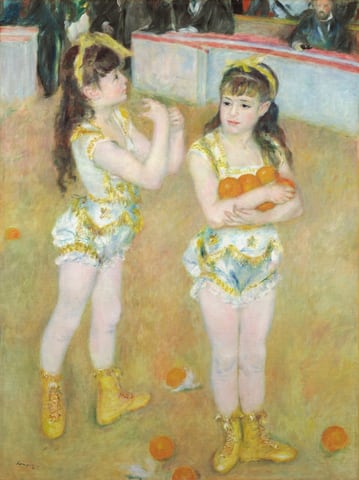
  1. Two girls in acrobatic uniforms stand in an arena, one holds oranges.
    Acrobats at the Cirque Fernando (Francisca and Angelina Wartenberg)Pierre-Auguste Renoir, 1879Courtesy of the Art Institute of Chicago
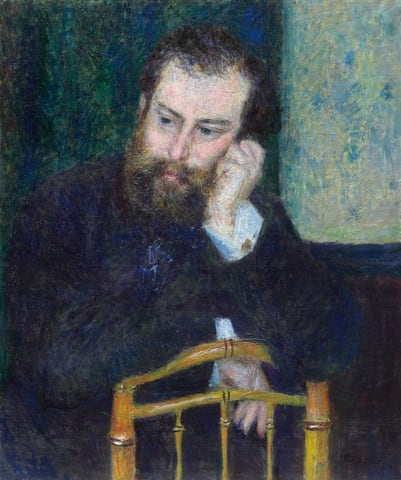
  2. A work made of oil on canvas.
    Alfred SisleyPierre-Auguste Renoir, 1876Courtesy of the Art Institute of Chicago

Second room, north wall
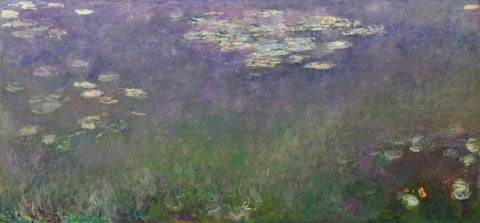
  1. Water Lilies (Agapanthus), by Claude Monet, c. 1915–26
    Water Lilies (Agapanthus)Claude Monet, c. 1915–26Courtesy of the Cleveland Museum of Art
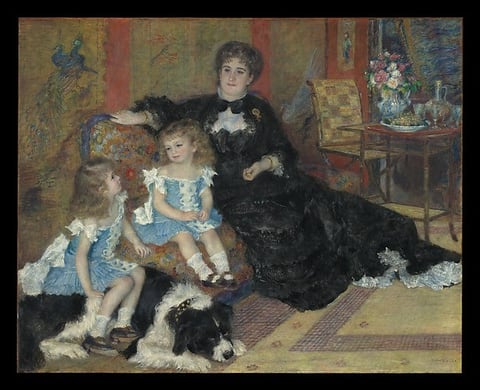
  2. Madame Georges Charpentier (Marguerite-Louise Lemonnier, 1848–1904) and Her Children, Georgette-Berthe (1872–1945) and Paul-Emile-Charles (1875–1895), by Pierre-Auguste Renoir, 1878
    Madame Georges Charpentier (Marguerite-Louise Lemonnier, 1848–1904) and Her Children, Georgette-Berthe (1872–1945) and Paul-Emile-Charles (1875–1895)Pierre-Auguste Renoir, 1878Courtesy of The Metropolitan Museum of Art

Third room, north wall
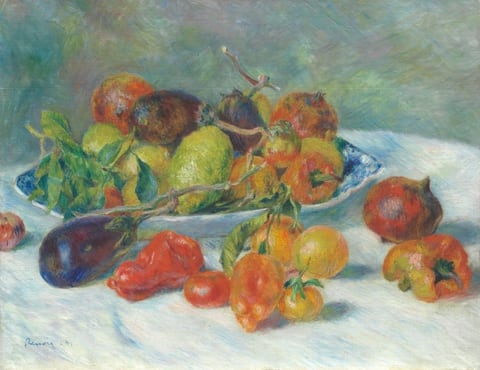
  1. A work made of oil on canvas.
    Fruits of the MidiPierre-Auguste Renoir, 1881Courtesy of the Art Institute of Chicago
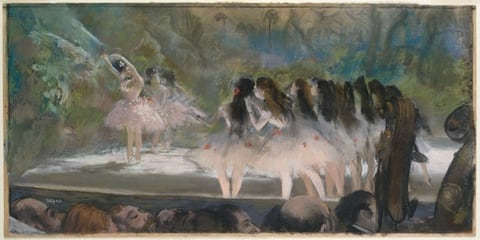
  2. Color pastel drawing of ballerinas in tutus on stage, watched by audience.
    Ballet at the Paris OpéraEdgar Degas, 1877Courtesy of the Art Institute of Chicago
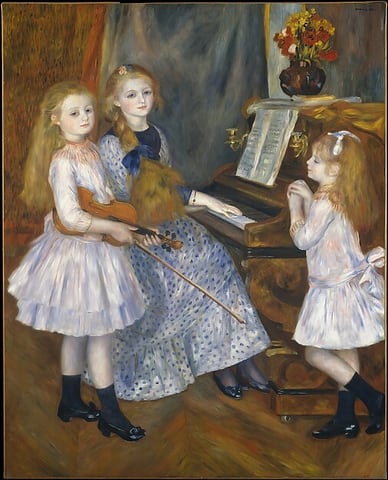
  3. The Daughters of Catulle Mendès, Huguette (1871–1964), Claudine (1876–1937), and Helyonne (1879–1955), by Pierre-Auguste Renoir, 1888
    The Daughters of Catulle Mendès, Huguette (1871–1964), Claudine (1876–1937), and Helyonne (1879–1955)Pierre-Auguste Renoir, 1888Courtesy of The Metropolitan Museum of Art

Third room, south wall
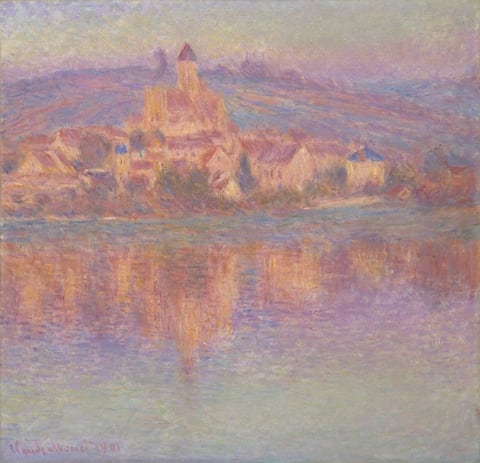
  1. A work made of oil on canvas.
    VétheuilClaude Monet, 1901Courtesy of the Art Institute of Chicago
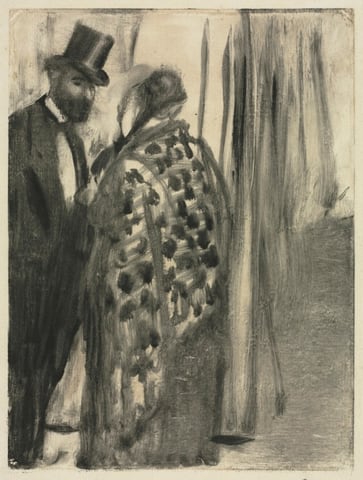
  2. Conversation: Ludovic Halévy and Madame Cardinal (The Conversation) for "La Famille Cardinal" by Ludovic Halévy, by Edgar Degas, c. 1880–83
    Conversation: Ludovic Halévy and Madame Cardinal (The Conversation) for "La Famille Cardinal" by Ludovic HalévyEdgar Degas, c. 1880–83Courtesy of the Cleveland Museum of Art
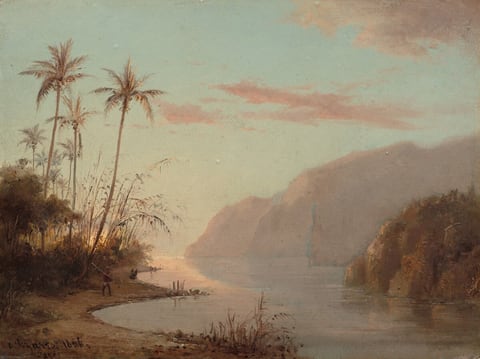
  3. A wide creek winds between a tree-lined bank to our left and hazy mountains to our right in this horizontal landscape painting. The riverbank curves deeply like a backward capital letter B. Marshy grasses grow in tufts, and palm and other trees grow in a grove to our left. One brown-skinned person wearing only a white cloth around the hips carries a long stick near the shoreline. Dabs of brown and muted dark pink suggest other people farther along the riverside. Tree-covered boulders jut into the creek from our right. A band of rocky, mountains are smoky mauve-pink across the rightmost two-thirds of the horizon, which comes a third of the way up the composition. The butter-yellow sun is low on the horizon to our right, peeking through the grove of palm trees. The light pours across the placid surface of the creek, creating a soft yellow streak next to the reflection of the mountain ridge. A few heather-pink clouds drift across the pale turquoise sky. The artist signed and dated the painting in the lower left corner, “C. Pizarro. 1856. Paris.”
    A Creek in St. Thomas (Virgin Islands)Camille Pissarro, 1856Courtesy National Gallery of Art, Washington