Floor plan

East wing: The Nineteenth CenturyImpressionism

Impressionism

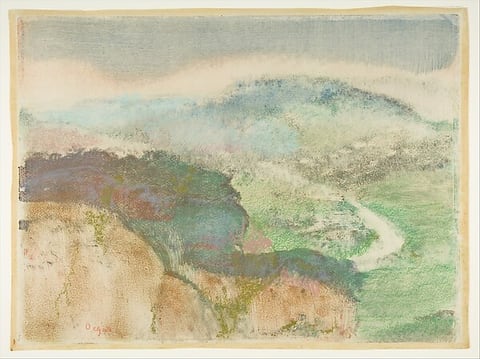
Landscape, by Edgar Degas, 1892
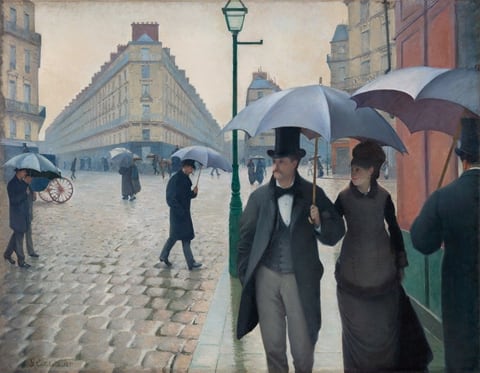
Life-size painting of an urban scene in Paris. A man in a top hat holding an umbrella and a woman in a long fashionable dark dress walk arm in arm toward the viewer as other city dwellers with umbrellas walk in various directions across cobblestone roads and sidewalks.
A work made of oil on canvas.
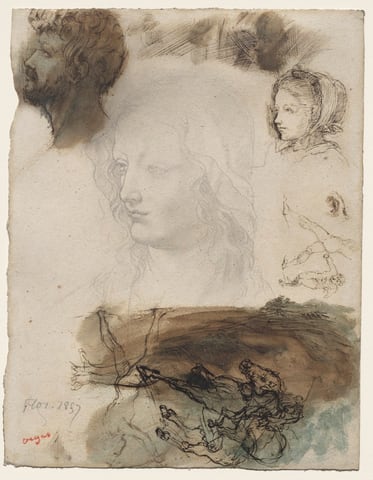
Sheet of Studies and Sketches, by Edgar Degas, 1858
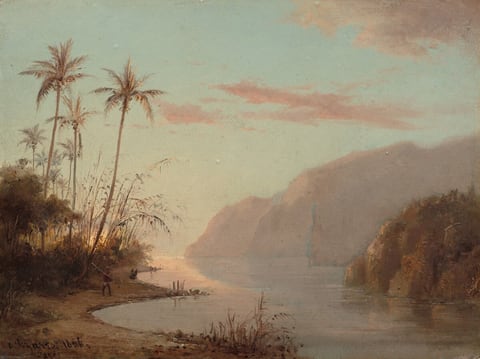
A wide creek winds between a tree-lined bank to our left and hazy mountains to our right in this horizontal landscape painting. The riverbank curves deeply like a backward capital letter B. Marshy grasses grow in tufts, and palm and other trees grow in a grove to our left. One brown-skinned person wearing only a white cloth around the hips carries a long stick near the shoreline. Dabs of brown and muted dark pink suggest other people farther along the riverside. Tree-covered boulders jut into the creek from our right. A band of rocky, mountains are smoky mauve-pink across the rightmost two-thirds of the horizon, which comes a third of the way up the composition. The butter-yellow sun is low on the horizon to our right, peeking through the grove of palm trees. The light pours across the placid surface of the creek, creating a soft yellow streak next to the reflection of the mountain ridge. A few heather-pink clouds drift across the pale turquoise sky. The artist signed and dated the painting in the lower left corner, “C. Pizarro. 1856. Paris.”
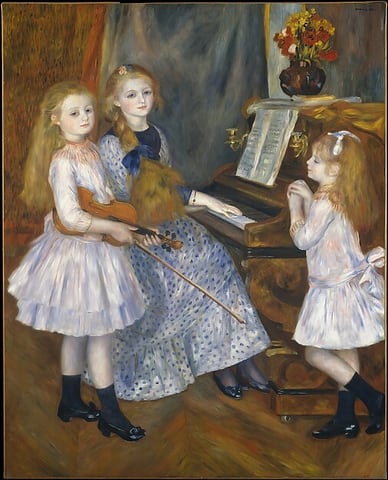
The Daughters of Catulle Mendès, Huguette (1871–1964), Claudine (1876–1937), and Helyonne (1879–1955), by Pierre-Auguste Renoir, 1888

The works in this room are listed below.

Works in this room

Painters in 1870s Paris who worked quickly, often outdoors, to catch light as it changed.

First room, north wall

  1. Landscape, by Edgar Degas, 1892
    LandscapeEdgar Degas, 1892Courtesy of The Metropolitan Museum of Art
  2. Life-size painting of an urban scene in Paris. A man in a top hat holding an umbrella and a woman in a long fashionable dark dress walk arm in arm toward the viewer as other city dwellers with umbrellas walk in various directions across cobblestone roads and sidewalks.
    Paris Street; Rainy DayGustave Caillebotte, 1877Courtesy of the Art Institute of Chicago

First room, south wall

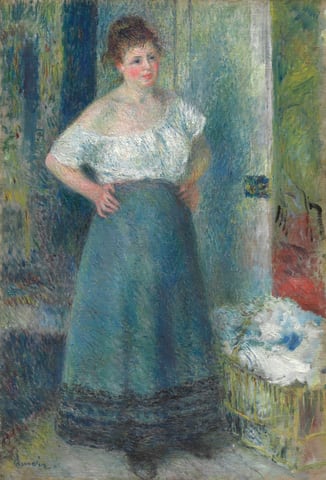
  1. A work made of oil on canvas.
    The LaundressPierre-Auguste Renoir, 1877–79Courtesy of the Art Institute of Chicago
  2. Sheet of Studies and Sketches, by Edgar Degas, 1858
    Sheet of Studies and SketchesEdgar Degas, 1858Courtesy of the Cleveland Museum of Art
  3. A wide creek winds between a tree-lined bank to our left and hazy mountains to our right in this horizontal landscape painting. The riverbank curves deeply like a backward capital letter B. Marshy grasses grow in tufts, and palm and other trees grow in a grove to our left. One brown-skinned person wearing only a white cloth around the hips carries a long stick near the shoreline. Dabs of brown and muted dark pink suggest other people farther along the riverside. Tree-covered boulders jut into the creek from our right. A band of rocky, mountains are smoky mauve-pink across the rightmost two-thirds of the horizon, which comes a third of the way up the composition. The butter-yellow sun is low on the horizon to our right, peeking through the grove of palm trees. The light pours across the placid surface of the creek, creating a soft yellow streak next to the reflection of the mountain ridge. A few heather-pink clouds drift across the pale turquoise sky. The artist signed and dated the painting in the lower left corner, “C. Pizarro. 1856. Paris.”
    A Creek in St. Thomas (Virgin Islands)Camille Pissarro, 1856Courtesy National Gallery of Art, Washington
  4. The Daughters of Catulle Mendès, Huguette (1871–1964), Claudine (1876–1937), and Helyonne (1879–1955), by Pierre-Auguste Renoir, 1888
    The Daughters of Catulle Mendès, Huguette (1871–1964), Claudine (1876–1937), and Helyonne (1879–1955)Pierre-Auguste Renoir, 1888Courtesy of The Metropolitan Museum of Art

Second room, south wall
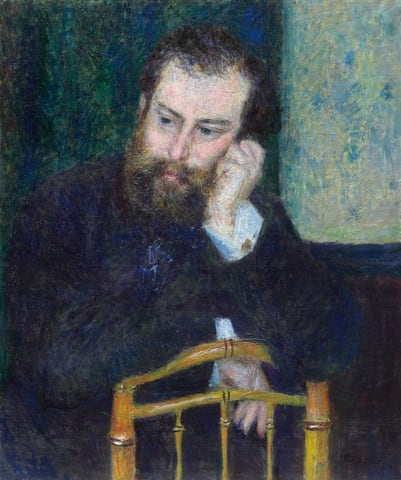
  1. A work made of oil on canvas.
    Alfred SisleyPierre-Auguste Renoir, 1876Courtesy of the Art Institute of Chicago
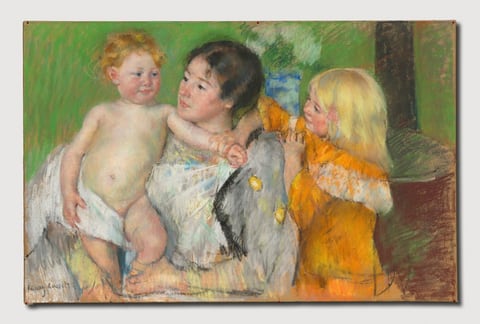
  2. After the Bath, by Mary Cassatt, 1901
    After the BathMary Cassatt, 1901Courtesy of the Cleveland Museum of Art
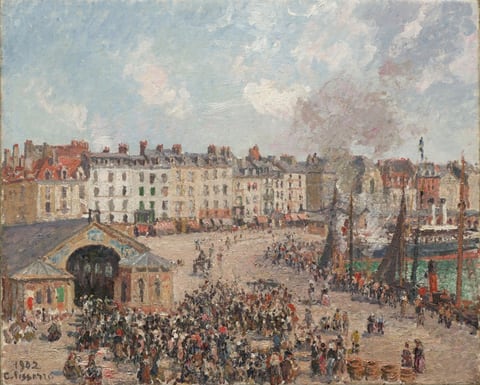
  3. Fishmarket, by Camille Pissarro, 1902
    FishmarketCamille Pissarro, 1902Courtesy of the Cleveland Museum of Art

Second room, north wall
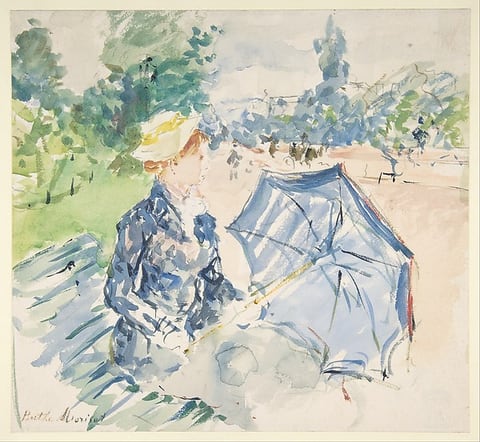
  1. A Woman Seated at a Bench on the Avenue du Bois, by Berthe Morisot, 1885
    A Woman Seated at a Bench on the Avenue du BoisBerthe Morisot, 1885Courtesy of The Metropolitan Museum of Art
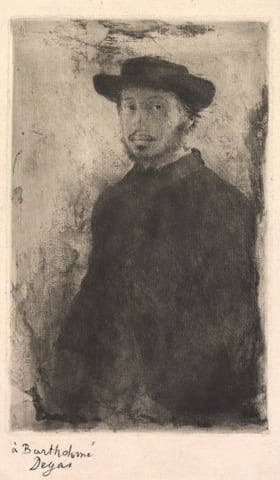
  2. Self-Portrait, by Edgar Degas, 1857
    Self-PortraitEdgar Degas, 1857Courtesy of the Cleveland Museum of Art
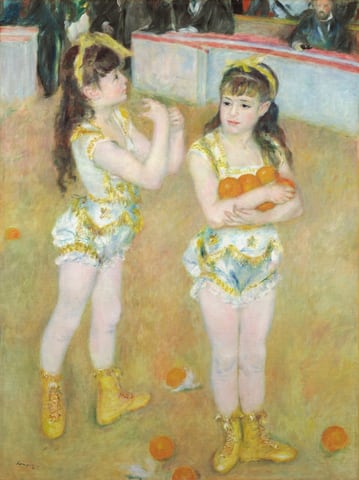
  3. Two girls in acrobatic uniforms stand in an arena, one holds oranges.
    Acrobats at the Cirque Fernando (Francisca and Angelina Wartenberg)Pierre-Auguste Renoir, 1879Courtesy of the Art Institute of Chicago
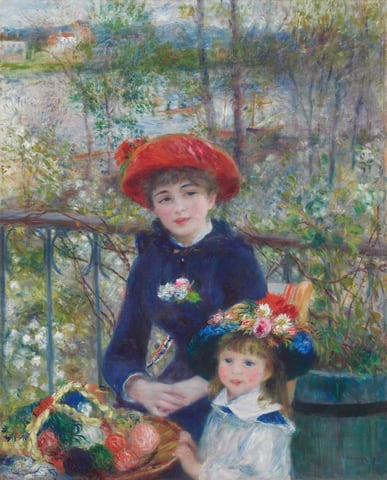
  4. Impressionist painting of two girls on balcony, bright flower hat, knitting basket.
    Two Sisters (On the Terrace)Pierre-Auguste Renoir, 1881Courtesy of the Art Institute of Chicago

Third room, north wall
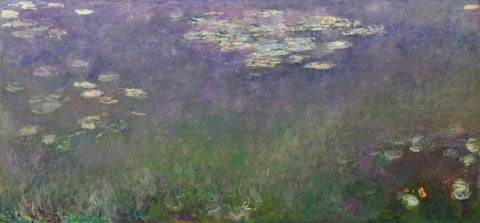
  1. Water Lilies (Agapanthus), by Claude Monet, c. 1915–26
    Water Lilies (Agapanthus)Claude Monet, c. 1915–26Courtesy of the Cleveland Museum of Art
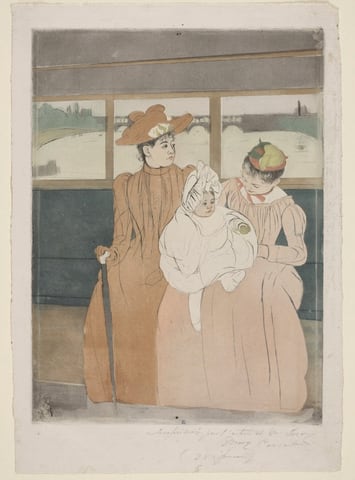
  2. In the Omnibus, by Mary Cassatt, 1890–91
    In the OmnibusMary Cassatt, 1890–91Courtesy of the Cleveland Museum of Art
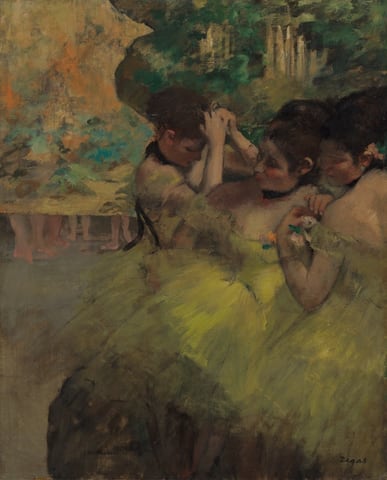
  3. Three light-skinned, dark-haired ballerinas, painted in muted tones, wear off-the-shoulder yellow leotards and tutus as they huddle near each other. One adjusts her costume, while one holds her hands clasped above her head. At left is a painted screen with four pairs of feet visible underneath.
    Yellow Dancers (In the Wings)Edgar Degas, 1874–76Courtesy of the Art Institute of Chicago