Floor plan

East wing: The Nineteenth CenturyImpressionism

Impressionism

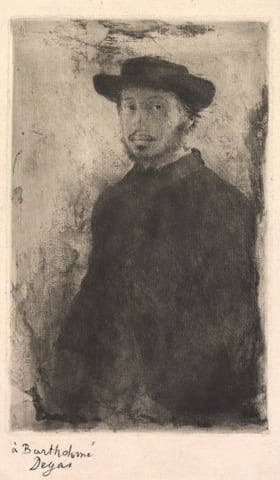
Self-Portrait, by Edgar Degas, 1857
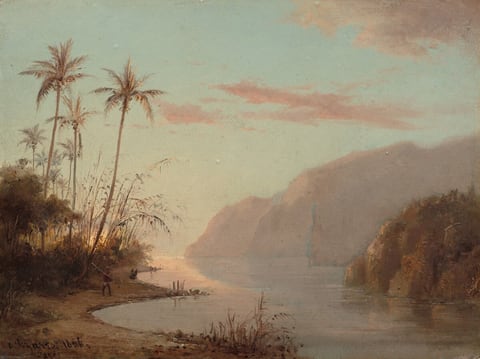
A wide creek winds between a tree-lined bank to our left and hazy mountains to our right in this horizontal landscape painting. The riverbank curves deeply like a backward capital letter B. Marshy grasses grow in tufts, and palm and other trees grow in a grove to our left. One brown-skinned person wearing only a white cloth around the hips carries a long stick near the shoreline. Dabs of brown and muted dark pink suggest other people farther along the riverside. Tree-covered boulders jut into the creek from our right. A band of rocky, mountains are smoky mauve-pink across the rightmost two-thirds of the horizon, which comes a third of the way up the composition. The butter-yellow sun is low on the horizon to our right, peeking through the grove of palm trees. The light pours across the placid surface of the creek, creating a soft yellow streak next to the reflection of the mountain ridge. A few heather-pink clouds drift across the pale turquoise sky. The artist signed and dated the painting in the lower left corner, “C. Pizarro. 1856. Paris.”
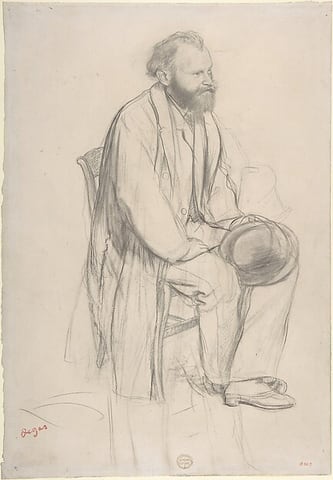
Édouard Manet, Seated, Holding His Hat, by Edgar Degas, ca. 1868
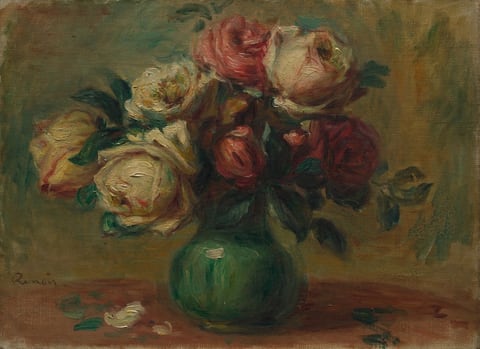
Roses in a Vase, by Pierre-Auguste Renoir, c. 1890
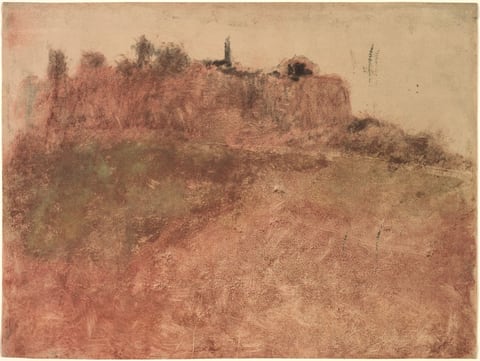
Estérel Village, by Edgar Degas, c. 1890
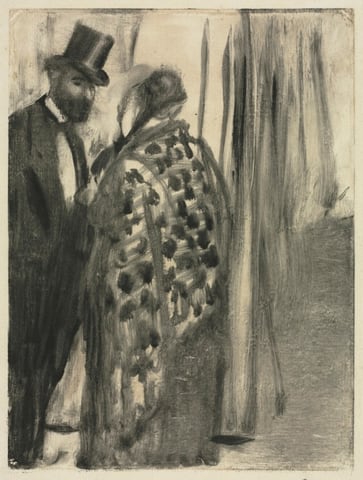
Conversation: Ludovic Halévy and Madame Cardinal (The Conversation) for "La Famille Cardinal" by Ludovic Halévy, by Edgar Degas, c. 1880–83
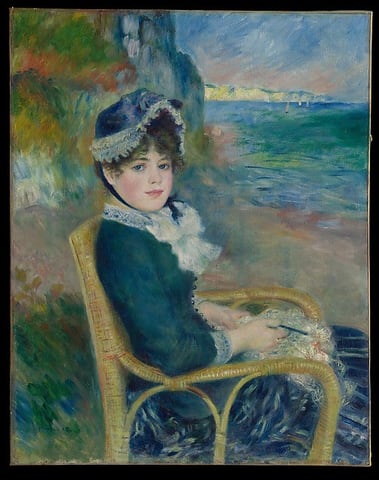
By the Seashore, by Pierre-Auguste Renoir, 1883
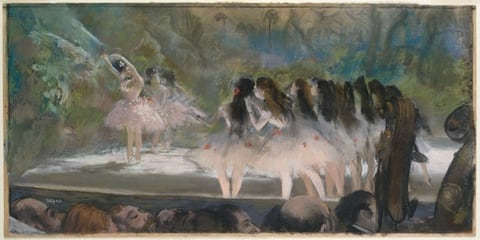
Color pastel drawing of ballerinas in tutus on stage, watched by audience.

The works in this room are listed below.

Works in this room

Painters in 1870s Paris who worked quickly, often outdoors, to catch light as it changed.

First room, north wall

  1. Self-Portrait, by Edgar Degas, 1857
    Self-PortraitEdgar Degas, 1857Courtesy of the Cleveland Museum of Art
  2. A wide creek winds between a tree-lined bank to our left and hazy mountains to our right in this horizontal landscape painting. The riverbank curves deeply like a backward capital letter B. Marshy grasses grow in tufts, and palm and other trees grow in a grove to our left. One brown-skinned person wearing only a white cloth around the hips carries a long stick near the shoreline. Dabs of brown and muted dark pink suggest other people farther along the riverside. Tree-covered boulders jut into the creek from our right. A band of rocky, mountains are smoky mauve-pink across the rightmost two-thirds of the horizon, which comes a third of the way up the composition. The butter-yellow sun is low on the horizon to our right, peeking through the grove of palm trees. The light pours across the placid surface of the creek, creating a soft yellow streak next to the reflection of the mountain ridge. A few heather-pink clouds drift across the pale turquoise sky. The artist signed and dated the painting in the lower left corner, “C. Pizarro. 1856. Paris.”
    A Creek in St. Thomas (Virgin Islands)Camille Pissarro, 1856Courtesy National Gallery of Art, Washington
  3. Édouard Manet, Seated, Holding His Hat, by Edgar Degas, ca. 1868
    Édouard Manet, Seated, Holding His HatEdgar Degas, ca. 1868Courtesy of The Metropolitan Museum of Art
  4. Roses in a Vase, by Pierre-Auguste Renoir, c. 1890
    Roses in a VasePierre-Auguste Renoir, c. 1890Courtesy of the Cleveland Museum of Art

First room, south wall

  1. Estérel Village, by Edgar Degas, c. 1890
    Estérel VillageEdgar Degas, c. 1890Courtesy of the Cleveland Museum of Art
  2. Conversation: Ludovic Halévy and Madame Cardinal (The Conversation) for "La Famille Cardinal" by Ludovic Halévy, by Edgar Degas, c. 1880–83
    Conversation: Ludovic Halévy and Madame Cardinal (The Conversation) for "La Famille Cardinal" by Ludovic HalévyEdgar Degas, c. 1880–83Courtesy of the Cleveland Museum of Art
  3. By the Seashore, by Pierre-Auguste Renoir, 1883
    By the SeashorePierre-Auguste Renoir, 1883Courtesy of The Metropolitan Museum of Art
  4. Color pastel drawing of ballerinas in tutus on stage, watched by audience.
    Ballet at the Paris OpéraEdgar Degas, 1877Courtesy of the Art Institute of Chicago

Second room, south wall
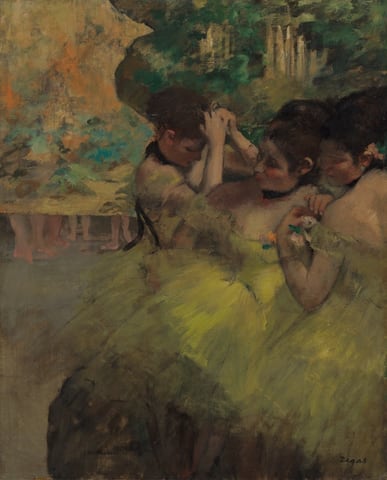
  1. Three light-skinned, dark-haired ballerinas, painted in muted tones, wear off-the-shoulder yellow leotards and tutus as they huddle near each other. One adjusts her costume, while one holds her hands clasped above her head. At left is a painted screen with four pairs of feet visible underneath.
    Yellow Dancers (In the Wings)Edgar Degas, 1874–76Courtesy of the Art Institute of Chicago
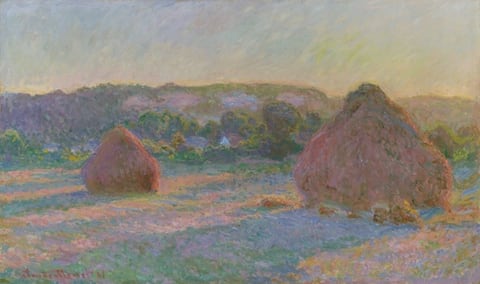
  2. Painting composed of short, dense brushstrokes depicts two domed stacks of wheat that cast long shadows on a field. The angled light indicates either a rising or setting sun.
    Stacks of Wheat (End of Summer)Claude Monet, 1890–91Courtesy of the Art Institute of Chicago
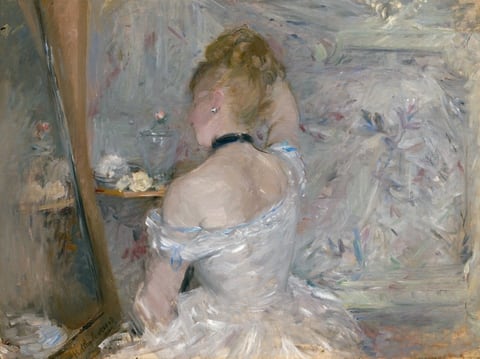
  3. Painted portrait dominated by loose, large brushstrokes of a woman, seen from the back, wearing a gauzy white off-the-shoulder dress and black choker, blond hair swept up, examining herself in a mirror at left. The background is a feathered swirl suggesting floral pattern in cool pale tones of gray, purple, pink, and blue.
    Woman at Her ToiletteBerthe Morisot, 1875–80Courtesy of the Art Institute of Chicago

Second room, north wall
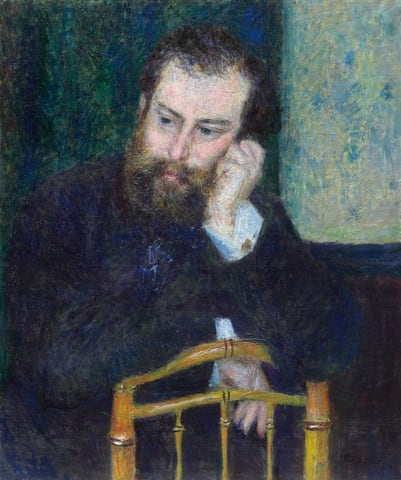
  1. A work made of oil on canvas.
    Alfred SisleyPierre-Auguste Renoir, 1876Courtesy of the Art Institute of Chicago
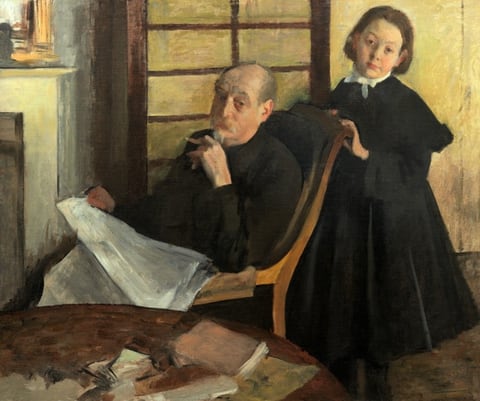
  2. Impressionist painting of seated man, girl with brown, black hues.
    Henri Degas and His Niece Lucie Degas (The Artist's Uncle and Cousin)Edgar Degas, 1875–76Courtesy of the Art Institute of Chicago
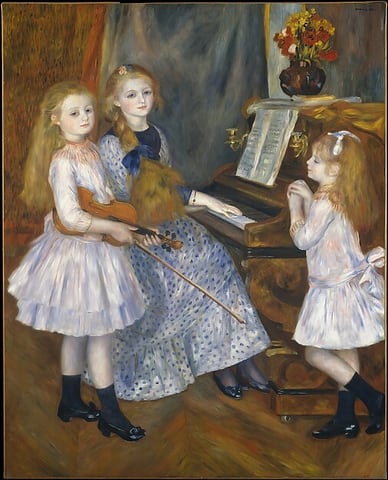
  3. The Daughters of Catulle Mendès, Huguette (1871–1964), Claudine (1876–1937), and Helyonne (1879–1955), by Pierre-Auguste Renoir, 1888
    The Daughters of Catulle Mendès, Huguette (1871–1964), Claudine (1876–1937), and Helyonne (1879–1955)Pierre-Auguste Renoir, 1888Courtesy of The Metropolitan Museum of Art

Third room, north wall
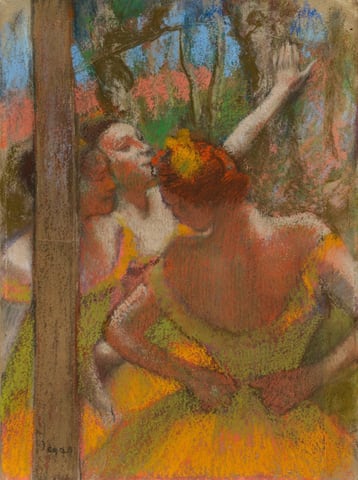
  1. Dancers, by Edgar Degas, c. 1896
    DancersEdgar Degas, c. 1896Courtesy of the Cleveland Museum of Art
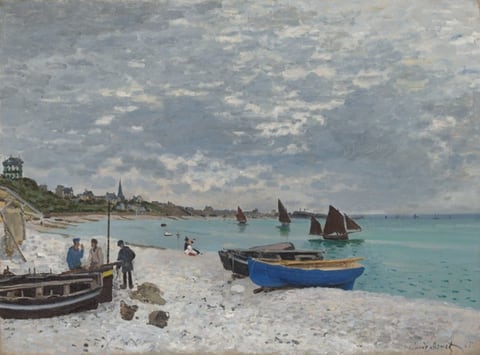
  2. Painting of a beach on a cloudy day with several sailboats on the water, a few rowboats on the shore, and two groupings of people on the sand.
    The Beach at Sainte-AdresseClaude Monet, 1867Courtesy of the Art Institute of Chicago