Floor plan

East wing: The Nineteenth CenturyImpressionism

Impressionism

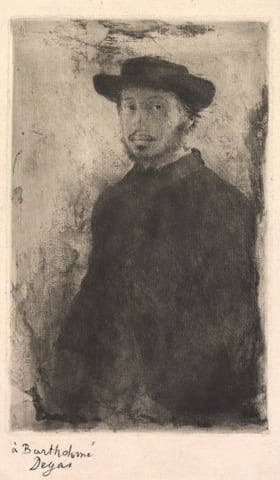
Self-Portrait, by Edgar Degas, 1857
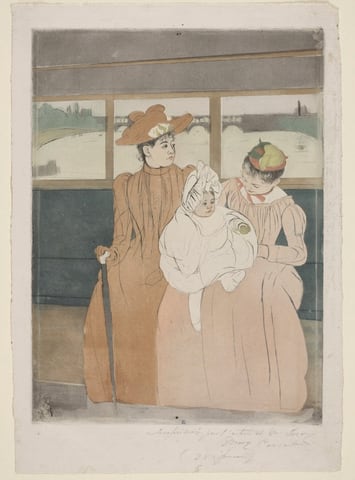
In the Omnibus, by Mary Cassatt, 1890–91
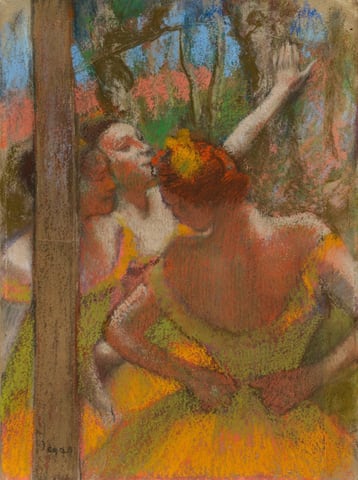
Dancers, by Edgar Degas, c. 1896
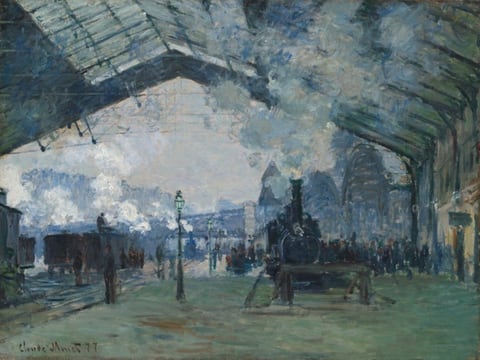
Loosely painted image of an open-air train station. On the right, a parked train gives off an enormous plumb of white smoke, making the scene look as though it were full of clouds. A huddled mass of barely discernible people crowd around the train on both sides of the tracks. Blue, green, and gray tones dominate.
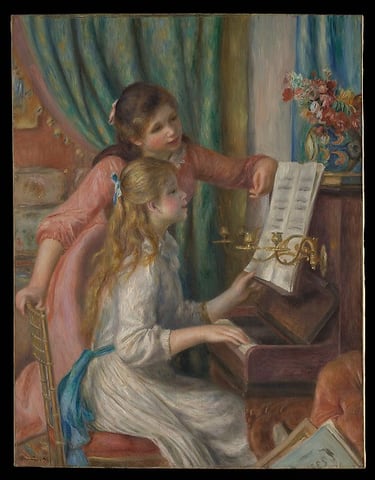
Two Young Girls at the Piano, by Pierre-Auguste Renoir, 1892
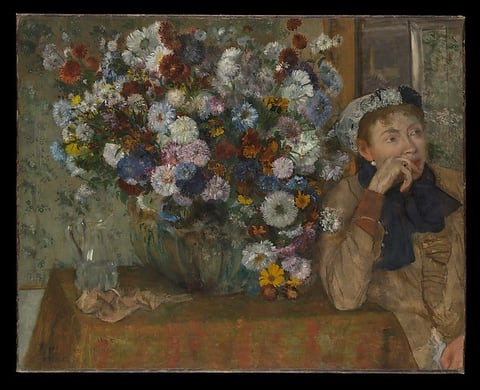
A Woman Seated beside a Vase of Flowers (Madame Paul Valpinçon?), by Edgar Degas, 1865

The works in this room are listed below.

Works in this room

Painters in 1870s Paris who worked quickly, often outdoors, to catch light as it changed.

First room, north wall

  1. Self-Portrait, by Edgar Degas, 1857
    Self-PortraitEdgar Degas, 1857Courtesy of the Cleveland Museum of Art
  2. In the Omnibus, by Mary Cassatt, 1890–91
    In the OmnibusMary Cassatt, 1890–91Courtesy of the Cleveland Museum of Art
  3. Dancers, by Edgar Degas, c. 1896
    DancersEdgar Degas, c. 1896Courtesy of the Cleveland Museum of Art
  4. Loosely painted image of an open-air train station. On the right, a parked train gives off an enormous plumb of white smoke, making the scene look as though it were full of clouds. A huddled mass of barely discernible people crowd around the train on both sides of the tracks. Blue, green, and gray tones dominate.
    Arrival of the Normandy Train, Gare Saint-LazareClaude Monet, 1877Courtesy of the Art Institute of Chicago

First room, south wall

  1. Two Young Girls at the Piano, by Pierre-Auguste Renoir, 1892
    Two Young Girls at the PianoPierre-Auguste Renoir, 1892Courtesy of The Metropolitan Museum of Art
  2. A Woman Seated beside a Vase of Flowers (Madame Paul Valpinçon?), by Edgar Degas, 1865
    A Woman Seated beside a Vase of Flowers (Madame Paul Valpinçon?)Edgar Degas, 1865Courtesy of The Metropolitan Museum of Art

Second room, south wall
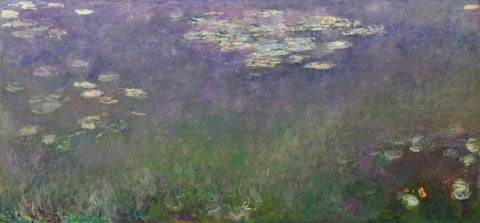
  1. Water Lilies (Agapanthus), by Claude Monet, c. 1915–26
    Water Lilies (Agapanthus)Claude Monet, c. 1915–26Courtesy of the Cleveland Museum of Art
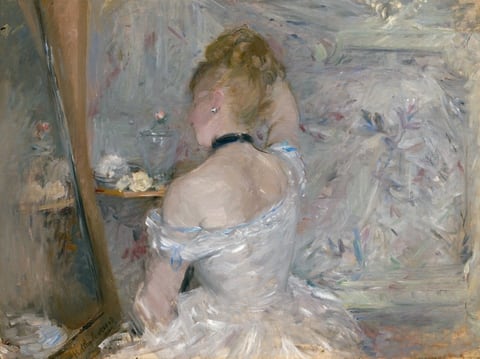
  2. Painted portrait dominated by loose, large brushstrokes of a woman, seen from the back, wearing a gauzy white off-the-shoulder dress and black choker, blond hair swept up, examining herself in a mirror at left. The background is a feathered swirl suggesting floral pattern in cool pale tones of gray, purple, pink, and blue.
    Woman at Her ToiletteBerthe Morisot, 1875–80Courtesy of the Art Institute of Chicago

Second room, north wall
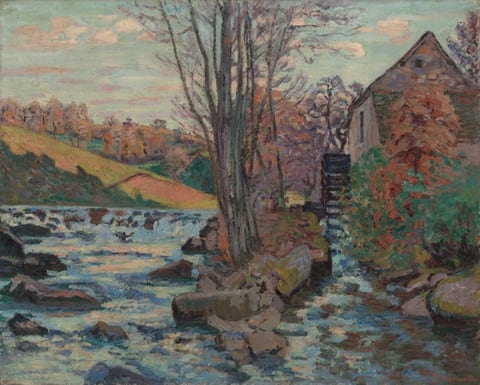
  1. A work made of oil on canvas.
    Mill of Pont MaupuitJean Baptiste Armand Guillaumin, c. 1900Courtesy of the Art Institute of Chicago
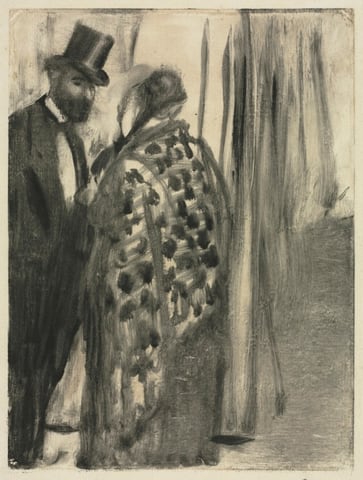
  2. Conversation: Ludovic Halévy and Madame Cardinal (The Conversation) for "La Famille Cardinal" by Ludovic Halévy, by Edgar Degas, c. 1880–83
    Conversation: Ludovic Halévy and Madame Cardinal (The Conversation) for "La Famille Cardinal" by Ludovic HalévyEdgar Degas, c. 1880–83Courtesy of the Cleveland Museum of Art
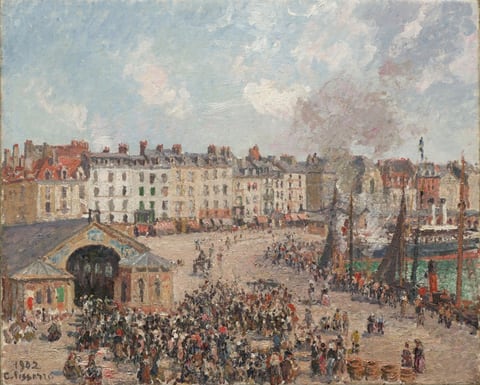
  3. Fishmarket, by Camille Pissarro, 1902
    FishmarketCamille Pissarro, 1902Courtesy of the Cleveland Museum of Art

Third room, north wall
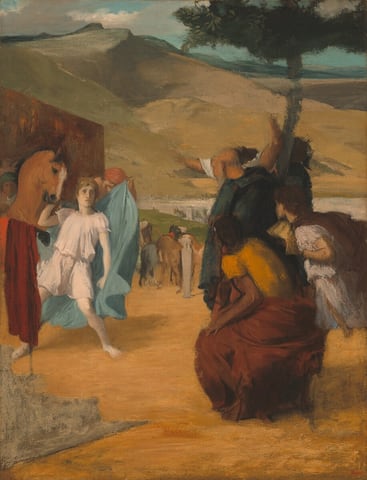
  1. Two groups of people face off in front of a hilly landscape in this loosely painted, vertical scene. On our left, a pale young man in a white tunic looks with eyes wide and lips parted at a group of three people on our right. The young man's right hand, on our left, is raised to stroke the head of a reddish-brown horse at his right shoulder. He stands with feet planted wide, knees bent, and he curls his left hand into a fist. Behind him, a man holds up a fluttering, light blue cape. A mottled red wall forms a backdrop to this scene on our left. The tight group gathered under a tree on our right stares back at the young man. The trio is made up of a balding, older man, a light-skinned boy also wearing a white tunic, and, closest to us, a brown-skinned woman wearing a marigold-orange shirt and a maroon-red skirt. Behind this group, a pair of pale raised arms suggests a fourth person, but the head is missing or has been painted over. The ground under the people is saffron orange. In the center of the picture, beyond the people, a group of horses stands near a green bank by a river, its surface reflecting white. The far bank is lined with white buildings. Tan and olive-green slopes rise from the opposite riverbank under a pale blue sky with cream-white clouds sweeping along the top edge of the composition. The artist signed his name in red paint in the lower right corner: “Degas.”
    Alexander and BucephalusEdgar Degas, 1861/1862Courtesy National Gallery of Art, Washington
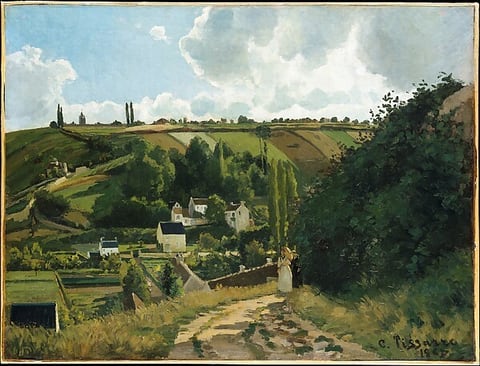
  2. Jalais Hill, Pontoise, by Camille Pissarro, 1867
    Jalais Hill, PontoiseCamille Pissarro, 1867Courtesy of The Metropolitan Museum of Art
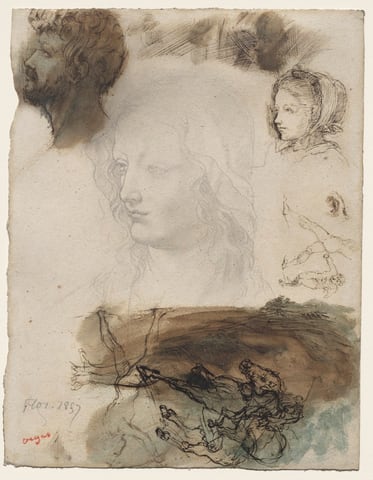
  3. Sheet of Studies and Sketches, by Edgar Degas, 1858
    Sheet of Studies and SketchesEdgar Degas, 1858Courtesy of the Cleveland Museum of Art

Third room, south wall
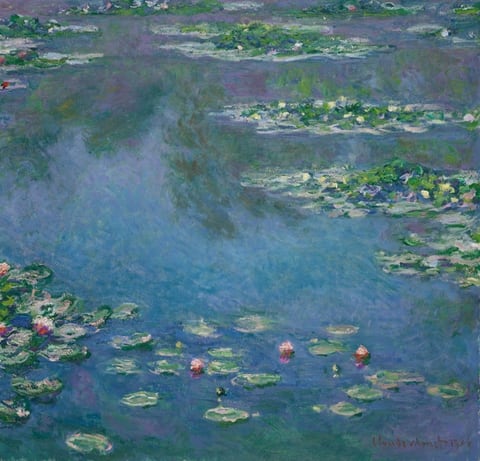
  1. Painting of a pond seen up close spotted with thickly painted pink and white water lilies and a shadow across the top third of the picture.
    Water LiliesClaude Monet, 1906Courtesy of the Art Institute of Chicago
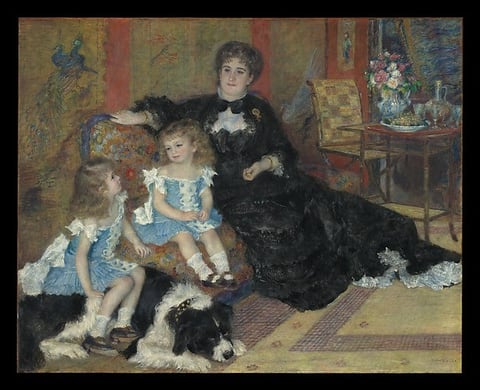
  2. Madame Georges Charpentier (Marguerite-Louise Lemonnier, 1848–1904) and Her Children, Georgette-Berthe (1872–1945) and Paul-Emile-Charles (1875–1895), by Pierre-Auguste Renoir, 1878
    Madame Georges Charpentier (Marguerite-Louise Lemonnier, 1848–1904) and Her Children, Georgette-Berthe (1872–1945) and Paul-Emile-Charles (1875–1895)Pierre-Auguste Renoir, 1878Courtesy of The Metropolitan Museum of Art