Floor plan

Style galleriesNeoclassicism

Neoclassicism

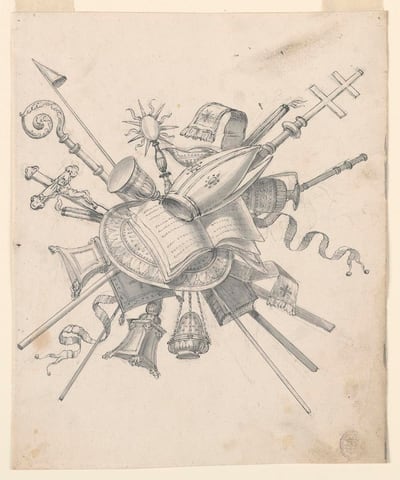
TROPHY WITH ECCLESIASTICAL OBJECTS
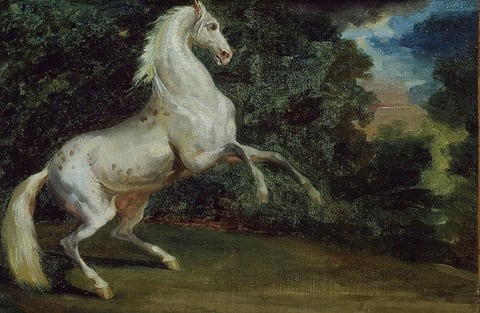
A work made of oil on canvas.
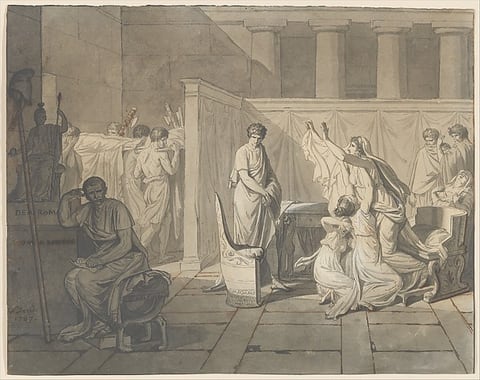
The Lictors Bringing Brutus the Bodies of his Sons, by Jacques-Louis David, 1787
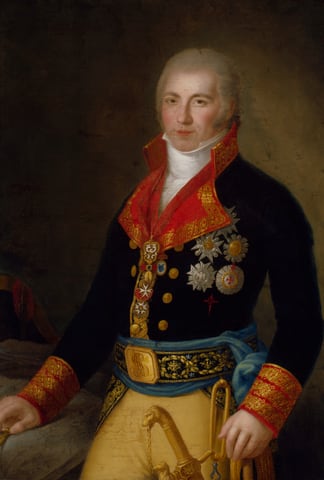
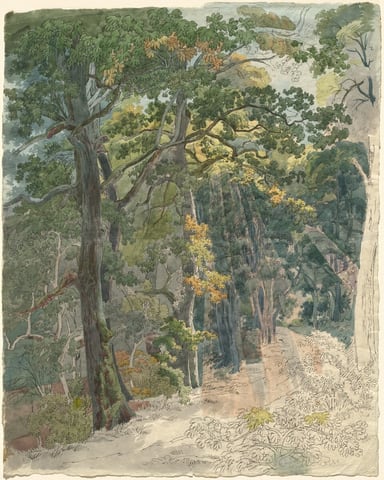
A work made of oil on canvas.
The image shows a dense, forested area with towering trees. The composition leads the eye along a pathway into the distance, without a distinct horizon line. The intricate brushstrokes depict the texture and foliage of the trees, suggesting movement and light filtering through the leaves. The color palette is rich and earthy, with shades of green, brown, yellow, and orange, creating a vibrant yet tranquil atmosphere emphasizing light and shadow.

The works in this room are listed below.

Works in this room

Europe turns back to Greece and Rome: clear line, calm figures and civic virtue.

First room, north wall

  1. TROPHY WITH ECCLESIASTICAL OBJECTS
    Trophy with Ecclesiastical ObjectsRomolo Achille Liverani, 1830–1850Courtesy of Cooper Hewitt, Smithsonian Design Museum
  2. A work made of oil on canvas.
    Prancing HorseFollower of Jean Louis André Théodore Géricault, 1808–12Courtesy of the Art Institute of Chicago
  3. The Lictors Bringing Brutus the Bodies of his Sons, by Jacques-Louis David, 1787
    The Lictors Bringing Brutus the Bodies of his SonsJacques-Louis David, 1787Courtesy of The Metropolitan Museum of Art
  4. A work made of oil on canvas.
    Manuel GodoyAgustin Esteve y Marqués, 1800–8Courtesy of the Art Institute of Chicago

First room, south wall

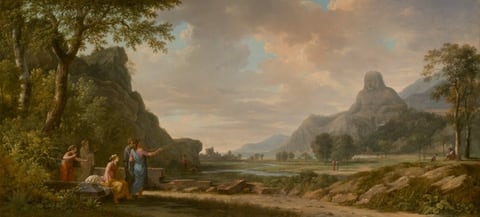
  1. A work made of oil on canvas.
    Mount Athos Carved as a Monument to Alexander the GreatPierre Henri de Valenciennes, 1796Courtesy of the Art Institute of Chicago
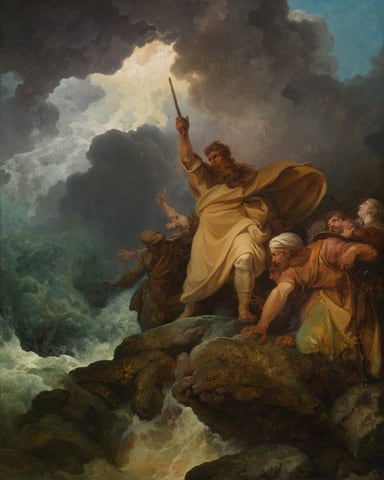
  2. A work made of oil on canvas.
    The Destruction of Pharaoh's ArmyPhilippe Jacques de Loutherbourg, II, 1792Courtesy of the Art Institute of Chicago
  3. The image shows a dense, forested area with towering trees. The composition leads the eye along a pathway into the distance, without a distinct horizon line. The intricate brushstrokes depict the texture and foliage of the trees, suggesting movement and light filtering through the leaves. The color palette is rich and earthy, with shades of green, brown, yellow, and orange, creating a vibrant yet tranquil atmosphere emphasizing light and shadow.
    Rays of Sunlight Striking a Woodland PathFriedrich Salathé, c. 1815Courtesy National Gallery of Art, Washington

Second room, south wall
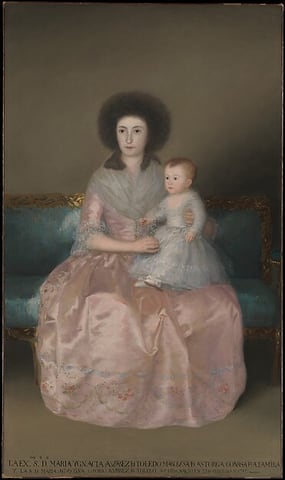
  1. Condesa de Altamira and Her Daughter, María Agustina, by Francisco Goya, 1787–88
    Condesa de Altamira and Her Daughter, María AgustinaFrancisco Goya, 1787–88Courtesy of The Metropolitan Museum of Art
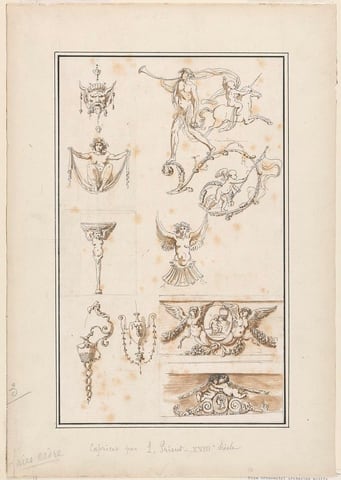
  2. DESIGNS FOR ORNAMENTAL ARABESQUE MOTIFS
    Designs for Ornamental Arabesque MotifsEtienne de Lavallée-Poussin, 1770Courtesy of Cooper Hewitt, Smithsonian Design Museum
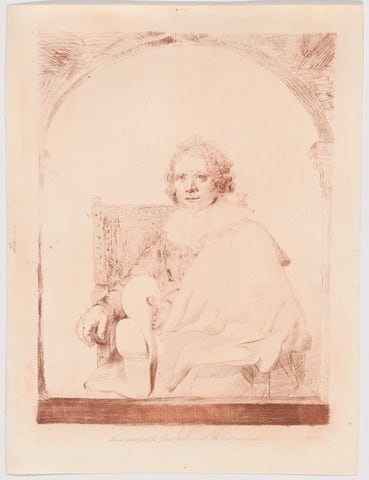
  3. A work made of soft ground etching, with roulette, printed in red on white wove paper.
    Portrait of a Man in an Armchair, from Collection d'imitations de Dessins d'après les Principaux Maîtres Hollandais et FlamandsChristian Josi, 1826Courtesy of the Art Institute of Chicago

Second room, north wall
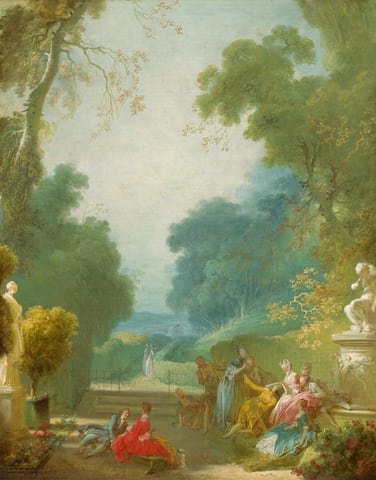
  1. Towering, pale, celery-green trees frame a view of a lush park with about a dozen elegantly dressed, light-skinned men and women in this vertical landscape painting. The color palette is dominated by moss and lemon-lime green, golden yellow, and spruce blue. The men all wear jackets with long tails over knee-breeches, and their long hair is pulled back at the napes of their necks. The women wear long dresses with full skirts and hints of lace at the sleeves and bust, and their brown or white hair is pulled up. Nine of the men and women gather to our right on a stone terrace along the bottom edge of the painting. A man in butter yellow kneels in front of a woman wearing rose pink. Around this pair, people stand, kneel, sit, or recline wearing aquamarine blue, light turquoise, or ivory white. A man and woman sit on a bench to our left, a little removed from the larger group. This woman wears ruby red and the man leaning toward her wears topaz blue. Two people in the park beyond these groups are painted with only a few strokes of pale blue and white paint, and they look over a low hedge row lining the walking path. Beds of red flowers fill the lower corners of the composition in front of a statue of a woman to our left and a person, perhaps on a fountain, to our right. The grassy walking path and trees become more blue as they fade into the hazy distance between the tall tress to either side. The sky fades from pale blue along the horizon to a silvery blue, almost white, at the top.
    A Game of Hot CocklesJean Honoré Fragonard, c. 1775/1780Courtesy National Gallery of Art, Washington
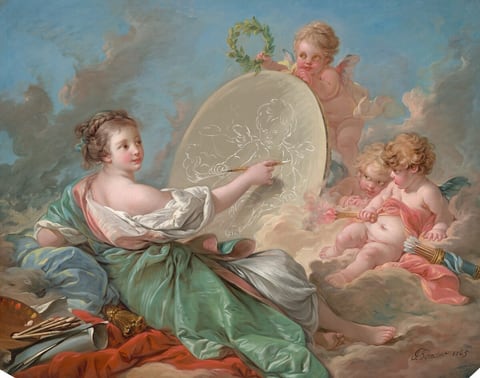
  2. A young woman draws on an oval surface with white chalk while three winged, baby-like putti gather nearby, all on a bank of pale pink clouds in this horizontal painting. The woman and putti have pale, rosy skin, flushed cheeks, and hazel-brown eyes. To our left, the woman reclines with her upper body propped up on her far elbow, which rests on a steel-blue cushion as her legs stretch out to our right. Her light brown hair is braided and wrapped across the top of her head. She wears a loose, seafoam-green robe over a billowing ivory-white garment that has slipped off the shoulder closer to us. A round paint palette with brushes sticking out of its thumb hole and a roll of blue and white paper sit in the lower left corner, behind the woman. The woman and the objects are on a red cloth. In front of the woman is a rounded surface, perhaps a canvas, on which she draws. She holds up a gold-colored stylus with her right hand, closer to us, with a pointed piece of white chalk in one end and black chalk in the other. The canvas is taller than her head, so the child-like putto she draws on it is life-sized. The three nude putti on the far side of the canvas have copper or golden-blond, curly hair, flushed, rounded cheeks, short wings in white or peacock blue, pudgy torsos, and dimpled limbs. One putto, presumably the one the woman draws, sits back on the bank of clouds with a carnation-pink sash across his chest. He pulls his chin back and looks at her from under his eyebrows. He holds a gold-colored torch with a pink flame in one hand, and the other hand rests near a cylindrical quiver of arrows. Another putto peeks around the side of the canvas, and the third stands and props the canvas up. That third putto holds up a wreath of laurel leaves up over the canvas, above the woman’s drawing hand. The bank of clouds is parchment-brown with muted pink and blue highlights against a vivid blue sky. The artist signed and dated the lower right, “F Boucher – 1765.”
    Allegory of PaintingFrançois Boucher, 1765Courtesy National Gallery of Art, Washington

Third room, north wall
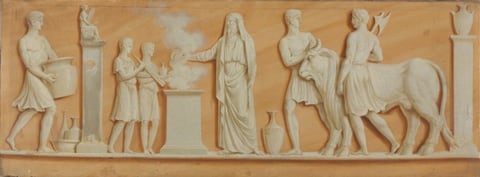
  1. Overdoor Painting, by Pierre Rousseau, 1790s
    Overdoor PaintingPierre Rousseau, 1790sCourtesy of the Cleveland Museum of Art
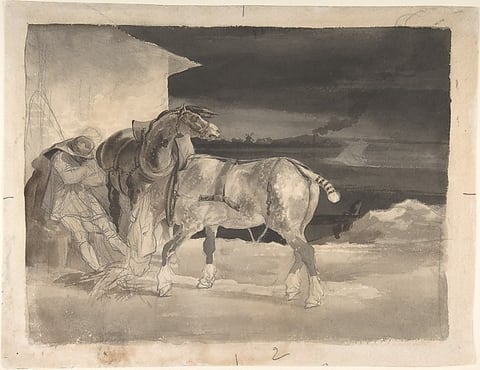
  2. Two Draft Horses with a Sleeping Driver, by Jean Louis André Théodore Géricault, 1820–22
    Two Draft Horses with a Sleeping DriverJean Louis André Théodore Géricault, 1820–22Courtesy of The Metropolitan Museum of Art

Third room, south wall

  1. A work made of etching with roulette in black on ivory wove paper.
    The Forest of RochecardonJean-Michel Grobon, 1800Courtesy of the Art Institute of Chicago
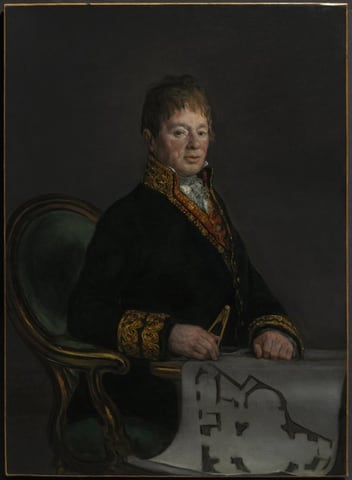
  2. Portrait of Don Juan Antonio Cuervo, by Francisco Goya, 1819
    Portrait of Don Juan Antonio CuervoFrancisco Goya, 1819Courtesy of the Cleveland Museum of Art